Your team comes back from the show with two hundred new contacts and a good feeling. Three weeks later, sales opens the list, cannot attach context to half the names, and most of it quietly goes cold. The booth looked great. The pipeline is empty. The budget is spent.
On the surface, everything worked. The graphics were sharp, the screen was big, and the aisle was busy. What nobody planned was the part between “a buyer walks past the booth” and “a real sales conversation gets booked.”
That gap is what this article is about: a booth that guides the right person, step by step, toward a conversation with a next step.
Short answer: what is a booth sales funnel?
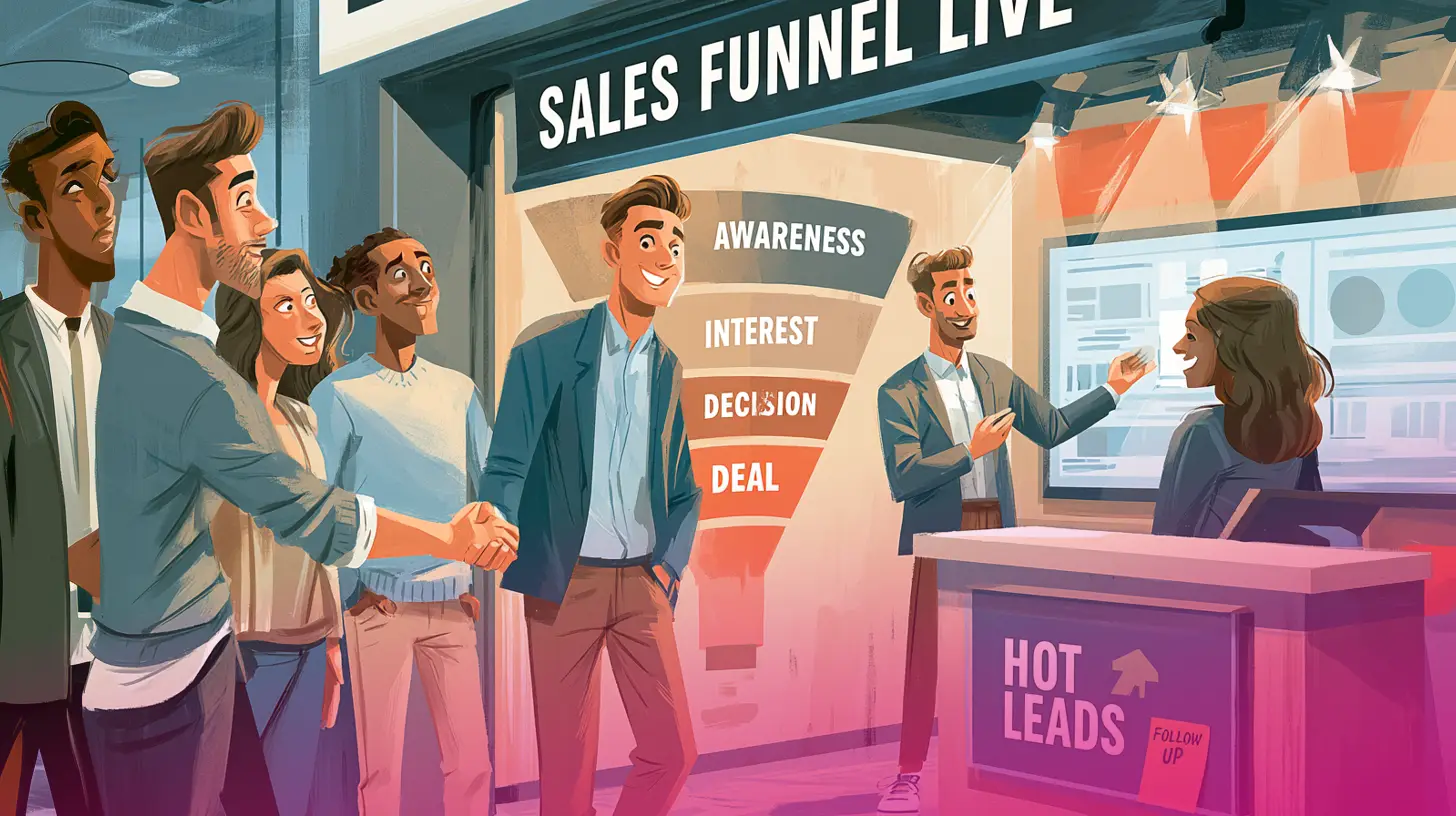
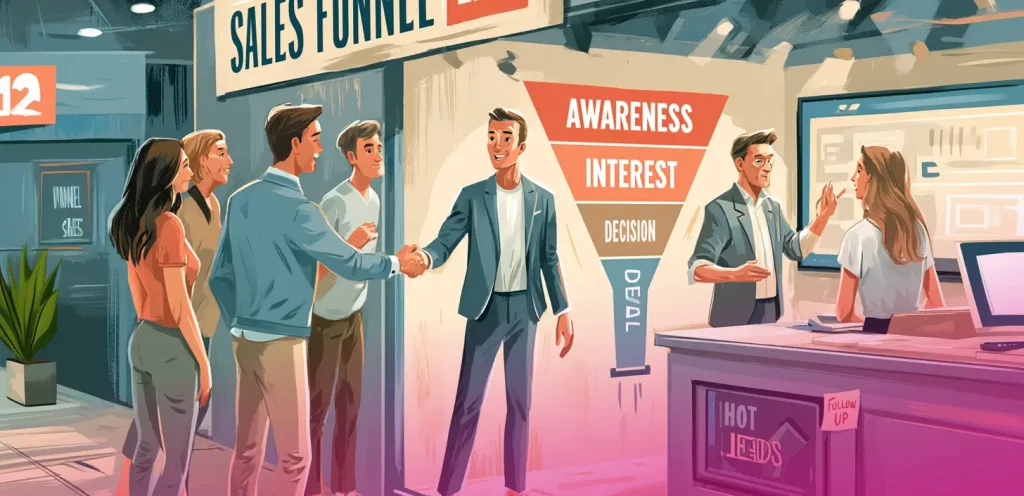
A booth sales funnel is a planned path that guides the right buyer from the first glance to an agreed next step: attention, fast qualification, proof of value, captured context, and follow-up.
The logic works in almost any market. First, attract the right person. Then check fit quickly, prove value, agree on the next step, and follow up after the event. What changes from one country to the next is how you open the conversation, how direct you are, how fast you respond, and what feels natural to people in that hall.
A strong booth has a planned path, and the team knows who attracts traffic, who qualifies, who runs the conversation, and who owns the next touch.
Why a good-looking booth isn’t enough
Trade shows are one of the most expensive ways to generate B2B sales conversations. According to Cvent’s 2026 benchmark, a lead from a live event can cost up to $811. That makes it one of the most expensive contacts in B2B marketing. When a contact like that gets lost at the booth or in follow-up, the problem is usually in the sales process, not in the booth build.
Companies often invest heavily in showing up, but prepare the post-show process much less carefully: lead notes, sales handoff, prioritization, and the first follow-up. That is where many expensive leads lose value, after the team gets back and sales does not have enough context to act.
The second trap is mistaking traffic for pipeline. Collecting a contact, scanning a badge, taking a business card, or adding a name to a list does not create a sales opportunity on its own. Without a conversation and context, sales often has no idea who was interested, what problem they had, or what next step was agreed.
A booth that only looks good and collects contacts produces a lot of data and very few real opportunities.
That is where a useful distinction begins:
What is visual at the booth, and what actually sells
| Booth element | Visual layer | Sales function |
|---|---|---|
| Wall message | headline, typography | stop the right person in a few seconds and name their problem |
| Booth layout | openness, aesthetics | let traffic enter without a barrier and guide people toward a conversation |
| Demo area | screens, equipment | prove value in a short, repeatable moment |
| Front attraction | attention-grabbing element | create a reason to start the conversation and filter the first layer of traffic |
| Meeting area | back wall, table, seating | agree on the next step with someone ready for a real conversation |
A good-looking build may impress leadership. The path and the people qualify the buyer.
Stage 1. Attention: a magnet that leads to a conversation
Traffic starts before the hall opens. When the audience is busy, senior, or hard to reach, you need to pull the right people in instead of waiting in the aisle.
Pre-show marketing genuinely moves booth traffic. Emails, meetings booked in advance, and visibility in the event app help the right people know about you before they enter the hall.
At the booth itself, you often need a magnet: a reason for the right person to stop. A well-chosen magnet works as a qualification tool. A bar, coffee, demo, short consultation, quiz, mini-audit, product test, benchmark, or sensory experience can all work, but only when they lead into a sales conversation. An attraction that pulls a crowd without starting a conversation is a cost, not an investment.
A strong magnet can turn a difficult event around. One of our client projects showed that clearly.
At an e-commerce show in London, we worked with a SaaS company selling pricing management software. The problem was simple: most visitors did not know the category yet. A headline about higher margins did not stop people, because first we had to explain what the company actually did.
So we built an entry point that fit the place and the audience: a bar with bartenders serving cocktails named after the client’s software releases. In that London context, the format matched the rhythm of the event. Traffic was heavy, and the lines were long enough that the team had to take short operational breaks.
The bar created the opening. Qualification started in the line, before anyone even got a drink.
That example worked because it fit one specific venue, event, audience, and city. The same idea in another market, industry, or format could feel misplaced, awkward, or hard to approve.
Alcohol at a booth is its own topic. In some countries and event formats it can work very well. In others it can feel too casual, create the wrong tone, or violate venue rules. It often requires organizer approval, service through the official caterer, fixed serving hours, or a ban outside official receptions. Check the idea early: culturally, formally, and commercially.
Stage 2. Fast qualification: the first filter
You stop the right person in a few seconds and qualify them in under a minute, before the wrong conversation takes up the team’s limited time.
This is the moment where people decide the outcome. Back to London. In the line for the bar, three people from the team were already talking to guests. They asked where visitors were from and whether they knew what price management was. That was the first filter, before anyone got a cocktail. Only then did the right people move on to a salesperson, and the bar turned from an attraction into a sales tool.
Good qualification at a show is short. Three questions are usually enough: the problem, the timeline, and the person’s role in the decision. It is a stripped-down version of the classic approach, tuned to the pace of the floor. Leave room for human judgment, though. A form can mislead you, because the young visitor your scoring model marks as “cold” may turn out to be the path to the decision-maker.
The data supports this approach. Cvent reports that 67 percent of trade show attendees are new sales contacts, and 72 percent are more likely to buy from an exhibitor they met in person. In other words, even a short conversation is worth more than a bare contact record.
The worst version is collecting everyone who walks by in exchange for a giveaway. The team wastes time on random traffic, and after the show sales receives a list with no context and writes it off as worthless. A better approach is to ask three questions and end the conversation politely when there is clearly no fit.
Stage 3. Demo and throughput: prove value without clogging the booth
Every booth needs a planned moment where interest turns into a concrete conversation. At trade shows, we often call that moment a demo, although in practice it can take different forms.
That moment has to be short and reliable. This is where the funnel either speeds up or gets stuck. Keep the proof point repeatable, a few minutes long, with a fast reset between visitors. Technical reliability matters too. A software demo running on free, overloaded venue Wi-Fi can freeze at the worst possible moment, which is why paid wired internet is often a condition for a demo that actually lands.
The value moment looks different across industries
In SaaS, the center of the booth is often a product demo: two stations, a screen, a specialist, and a short path that shows the problem, the solution, and the business outcome.
In other industries, this stage looks different. With industrial machinery, you often cannot bring the full product to the booth, especially a large production line or equipment that is too expensive to ship. The role of the demo may be taken by an animation, a 3D model, a video of the machine running, a material sample, a conversation with an engineer, or a well-prepared screen showing the key functions and applications.
In B2B services, the value moment may be a mini-audit, a benchmark, a short consultation, or a conversation with an expert. In medtech, it may be a procedure walkthrough, a clinical case, or an expert discussion. What matters is the planned step where interest turns into a concrete sales conversation, whether the path runs through a demo, a sample, or a consultation.
Then there is throughput, especially at industry events with a short sponsor-hall window. In that setting, what matters is how many buyers you can handle in a short period of time. Most competitors set up one demo station and one screen. For the same client from the London example, we usually ran at least two stations and two screens.
The reason is simple. When the window is short and the crowd is large, one station creates a bottleneck and some prospects walk away. Two stations handle more conversations in the same window.
A common mistake is one station and a long demo overloaded with technical detail. The result is a bottleneck, and good prospects leave before the conversation starts. A better approach is a short cycle, a clean reset, and more demo points wherever the window is tight.
Stage 4. Booth roles: who owns what
A strong booth needs a clear split of roles. That way your best salesperson spends time in sales conversations instead of scanning badges and handing out flyers.
In practice, the split looks like this:
- the attractor, who engages traffic at the front,
- the qualifier, who filters visitors in under a minute,
- the product expert, who runs the demo and answers technical questions,
- the relationship owner, who closes the conversation and sets the next step,
- the CRM owner, who protects the data and makes sure the handoff is clean.
On the London booth, you could see that split in practice: three people at the front attracting and qualifying, a salesperson closing the conversation, and product specialists running the demos.
At many booths, the problem starts when everyone does everything. The best salesperson hands out flyers, someone else captures random contacts, and no one actively works the front of the booth. A better approach is a clear split of roles and a clean handoff once the visitor is ready for the next stage.
The same funnel, different local execution
The same sales funnel can work across countries, but that does not mean it should look the same everywhere. You design the conversation one way for a U.S. show, another way in Germany, another in London, and differently again in Poland or at an industry event in Dubai.
The differences show up in how direct people expect you to be, how you invite a conversation, how comfortable the audience is with attractions at the booth, how alcohol is perceived, how quickly follow-up is expected, how formal the conversation should be, and what language or tone feels natural. Venue rules can also decide what you are allowed to do at the booth in the first place.
So the magnet should fit the market instead of being copied from one country to the next. A cocktail bar can be perfect at one event and feel misplaced, too casual, or simply against the rules at another. Sometimes the better magnet is coffee, a mini-audit, a benchmark, a short consultation, a product demo, or a private conversation with an expert.
The goal is to choose an entry point that fits the culture of the event and leads the right people into the right conversation.
This is where real preparation separates a working booth from a nice-looking build. A professional booth starts before the render. You need to know whether the idea makes sense in this country, at this event, and for this audience. We cover the realities of specific markets, such as what to watch for at U.S. trade shows, in separate articles.

Planning a trade show booth?
Make sure it has more than a strong design. Eventguru helps B2B companies plan the magnet, qualification flow, value moment, and follow-up behind the booth, so the event can lead to real sales conversations.
Let’s prepare your next show before the budget goes into production.
Stage 5. Lead capture and follow-up: where event budgets are most often lost
The funnel only works when a booth contact ends with an agreed next step, and the first follow-up goes out faster than your competitors’.
Capturing a lead is about more than collecting contact details. The team needs to record the context: what problem the buyer brought, what was promised, who owns the follow-up, and what next step was agreed. Without that context, follow-up turns generic, and a generic email makes the whole booth conversation look like it did not matter.
Then speed takes over. A classic 2007 study from MIT and InsideSales showed that reaching a lead within five minutes instead of thirty sharply raises the odds of qualifying it. Harvard Business Review pointed to the other side of the same mechanism in 2011: the average company took 42 hours to respond to a new contact, and 23 percent never responded at all.
Persistence counts too. One email rarely closes anything, because a post-show conversation seldom wraps up in a single touch. What usually works is a short cadence: an email, a call, a LinkedIn note, or a reminder tied to the specific conversation.
Follow-up timing is also worth tuning locally, because in some markets competitors respond almost immediately. The first touch with your best leads should go out within 24 to 48 hours, and the plan for it should be written before you travel. We cover the full post-event process in a separate article on post-event follow-up.
You can see the impact in the results. At the London show, thanks to filtering at the booth and careful work on the contacts afterward, the client gained more than a dozen new customers. One of them covered the entire cost of exhibiting within two years and generated additional profit. Three leads that looked unpromising at first came back later and turned into customers.
The worst post-show scenario is putting leads aside “for later” and sending one generic email to everyone. Contacts go cold, and a competitor takes the lead. After the event, sort leads into hot, warm, and cold, and make sure the most important ones hear from you within a day.
What to plan before the show
Most of the funnel is won before you travel, at the level of roles, questions, tools, and ready-to-use templates. Before you sign off on the booth render, check that you have:
- a magnet matched to the country, industry, time of day, event type, and rulebook, not copied from another market,
- venue rules and approvals for any attraction that needs sign-off, especially anything involving alcohol,
- an open layout with no barrier at the front,
- five roles assigned to named people,
- three qualifying questions the team has actually rehearsed,
- a lead-capture tool with fields for context and next step, integrated with your CRM before you leave,
- the number of demo stations matched to the sponsor-hall window, with at least two stations as an option when the window is short,
- follow-up templates written before departure,
- one person responsible for clean data before it goes into the CRM.
If the answer to any of these is “no,” it does not mean you should skip the show. It means there is work to do before the budget goes into production.
Stage Summary: the booth as a process, the magnet as a tool
A trade show booth is one of the most expensive tools in B2B sales. When it collects contacts without a plan and your best people hand out swag to anyone in the aisle, the budget disappears quickly.
The logic of the funnel works in every market: attention, qualification, value demo or expert conversation, next step, follow-up. What changes is how you invite the conversation. A magnet, whether it is a bar, coffee, or a mini-audit, earns its place only when it leads the right person into a qualified conversation and fits the culture of the event.
That is when the booth stops being a nice photo for the report and starts becoming the place where pipeline gets built.
Planning a trade show and want the booth to support real sales conversations? Contact Eventguru. We can help you plan the booth, the magnet, the qualification flow, and the follow-up before the budget goes into the build.