Factory Acceptance Tests and Site Acceptance Tests have always been high-stakes milestones. They gate payment, determine shipment readiness, and produce the documented evidence base that both buyer and supplier will reference if disputes arise later. For decades, conducting a FAT meant putting a team on a plane. When COVID-19 grounded travel and contracts still had to close, the industry discovered that a properly structured remote FAT could deliver the same outcomes – often with better documentation. What started as a workaround is now a deliberate choice for procurement and engineering teams managing complex supply chains. This article explains how we run it and what it takes to do it right.
1. Why remote FAT is a legitimate alternative - not a shortcut
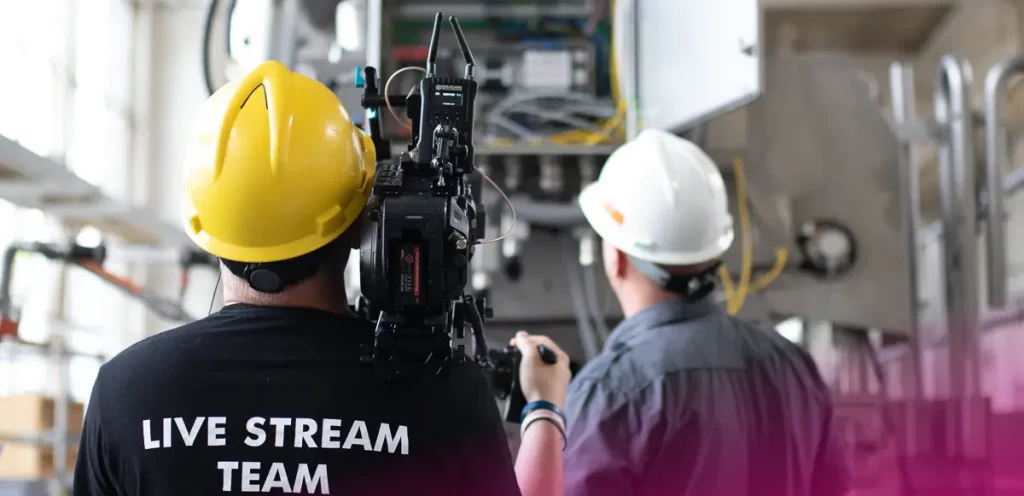
The concern we hear most often is that a camera cannot replace eyes on the equipment. That is partly true but also partly a misconception. A well-structured remote FAT is not a video call with someone holding a phone. We are using multiple calibrated video sources – a primary camera on a stabilized rig, close-range inspection cameras for weld seams, terminal blocks, sensor mounting and labelling, and directional microphones that cut through hall noise to capture machine acoustics and clear speakers voices. For outdoor or elevated assets, drone footage can cover rooftop penetrations, facade conditions, or site boundaries.
The FAT team retains full interactive control throughout: they can pause the walkthrough, call for a repeat of a functional sequence, request a specific camera angle, or flag an item for the punch list in real time. The discipline is comparable to a standard hold point or review point in an Inspection and Test Plan – the difference is that the sign-off team is not standing next to the equipment.
2.When remote FAT and SAT deliver the most value
Remote FAT is most effective when the project involves one or more of the following:
- Multi-party sign-off requirements – FATs and SATs often require simultaneous approval from engineering, QA, procurement, and the end client. Assembling all those stakeholders at a single location is logistically expensive and time-consuming. Remote streaming allows every party to attend the same test sequences concurrently, ask questions in real time, and contribute to the punch list without coordinating international travel.
- High inspection frequency – complex projects with phased delivery, parallel production lines, or multiple OEM suppliers require repeated FAT events. Running each one as an on-site visit is rarely cost-justified. Remote FAT reduces cost-per-event while maintaining test schedule.
- Compressed project timelines – when a hold point is blocking shipment and the next available travel window is two weeks out, a remote session arranged within 24 to 48 hours keeps the programme on track.
- Re-tests and punch list close-outs – verifying that NCRs have been resolved, or that a previously failed test sequence now performs to specification, rarely justifies full delegation travel. A focused remote session is more proportionate.
- SAT documentation and progress sign-off – for site acceptance phases, remote sessions allow project managers, owner’s engineers, or third-party inspectors to attend commissioning milestones without being permanently on-site.
We assess each project individually before recommending a format. Where the scope, test type, or site conditions make a fully remote FAT inappropriate, we say so and propose alternatives – including hybrid arrangements.
3. How we structure a remote FAT or SAT - step by step
- Scope and test plan alignment: we start by reviewing the Factory Test Procedure or Acceptance Test Procedure with the supplier and customer teams. We identify hold and review points and the critical-path test sequences, and establish the contractual documentation requirements.
- On-site lead selection and role assignment: The on-site lead needs to be technically credible – someone who understands the system architecture, can address questions from the remote FAT team, and operate the equipment confidently under live conditions. We brief them specifically on managing the session flow.
- Technical setup and connectivity verification: we select camera hardware appropriate to the test environment, configure the transmission platform (Teams, Zoom, a dedicated streaming solution, or VPN-routed workflow depending on client IT policy), and conduct a full connectivity test at the actual facility. Common failure points – upload bandwidth degraded by nearby welding equipment, IT firewall restrictions blocking external participants, HSE restrictions on recording in certain zones – are identified and resolved before the session date.
- Dress rehearsal: a structured pre-FAT run-through confirms that camera positions cover all critical test points, that the on-site lead is comfortable managing the camera operator and the remote FAT team simultaneously, and that the contingency procedure for connectivity loss is understood by all parties.
- Live FAT or SAT session: the test is executed in accordance with the agreed procedure. Remote participants can raise NCRs, request test repetitions, call for close-ups of nameplate data, serial numbers, weld quality, or control panel wiring, and record observations directly against checklist items. Where a test sequence needs to pause for a team discussion, we hold the stream and resume at the agreed point.
- Documentation package: on completion, we deliver a full recording indexed to the checklist, a signed-off punch list with open and closed items, photographic evidence referenced to specific test points, and a structured inspection report. Where required, the package can include 3D scan data for dimensional verification or as-built reference. All materials are delivered directly to the client’s document management system with no copies retained on our side.
4. What remote FAT and SAT measurably change for project teams
The operational impact we see most consistently:
- Faster milestone closure – a remote FAT can be scheduled within days of the supplier’s notification that equipment is ready. On-site visits are typically constrained by travel logistics, visa timelines, and accommodation availability. The difference in lead time is often two to four weeks.
- Reduction in delegation cost – mobilising three to five engineers across international borders for a two-day FAT frequently costs more than the remote inspection service itself. For projects with multiple FAT events, the cumulative saving is significant.
- More complete documentation as a standard output – because the session is recorded and indexed, the documentation package is more thorough and more immediately available than what a travelling team typically produces from handwritten notes and photographs taken between test sequences.
- Punch list traceability – open items are captured in real time during the session, assigned to responsible parties, and tracked through to close-out. Re-inspection of resolved items can be done as a short remote session without requiring return travel.
5. Data security, NDA compliance, and IT integration
Remote FATs involve equipment documentation, test data, system schematics, and in some cases commercially sensitive performance parameters. Security is not optional. Our standard approach includes: operating within the client’s own IT environment (Teams, Zoom, Webex, or VPN-routed workflow); controlling participant access through pre-approved attendee lists; executing NDAs before any session is configured; and agreeing data retention and deletion protocols before the first session. Recordings are deposited directly into the client’s document repository. We do not retain copies.
The most common technical friction point is not our setup – it is the client’s or supplier’s IT policy. Port restrictions, external-participant blocks, and recording prohibitions are frequent. We conduct a pre-session IT audit to identify these constraints and implement workarounds before the FAT date. We do not discover IT problems on the day of the inspection.
Flying in several specialists from different countries often means tens of thousands in travel costs and weeks of waiting for an available date. Remote FAT allows you to conduct a full technical acceptance test remotely — with a dedicated operator, a structured checklist, and a recording you can refer back to for months.
6. Case example: packaging line FAT with a mid-session scope change
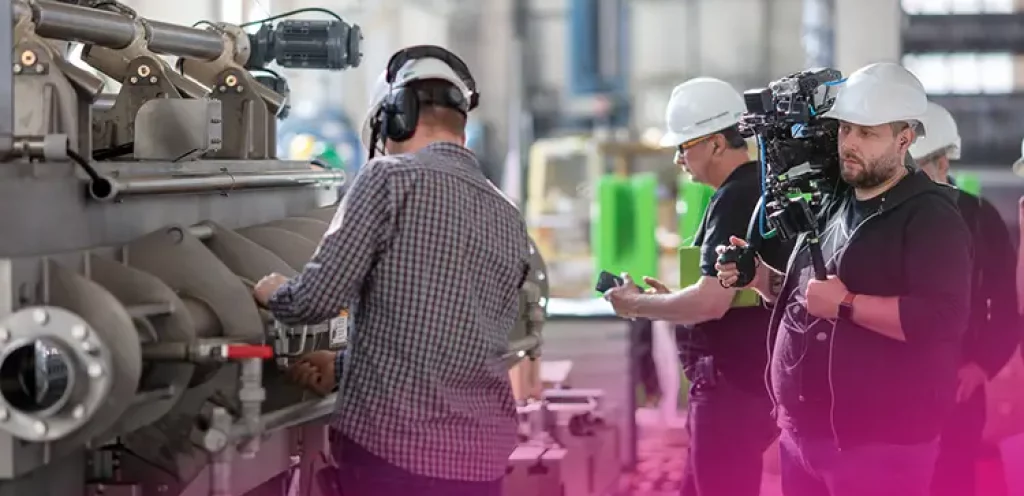
A customer needed to sign off on a high-speed packaging line prior to shipment. The session involved three client-side disciplines – QA, production engineering, and process technology – plus two system integrators on the supplier side and two camera operators from our team on the factory floor.
Forty minutes into the session, the facility’s fixed-line internet failed. We switched the full stream to an LTE backup connection within three minutes and continued without interruption. During the functional testing sequence, the client’s process engineer requested internal inspection of the product transfer pipework – a scope addition not included in the original test procedure. We deployed a push-rod inspection camera to cover internal weld condition and flow path geometry. The additional test point was logged against the checklist and indexed in the final report. The scope change added approximately fifteen minutes to the session.
This example reflects what we see consistently: the value of a remote FAT is not just the transmission quality. It is the process discipline around it – the contingency procedures, the ability to absorb scope changes without losing checklist integrity, and the readiness of the on-site team to operate under live conditions.
7.Summary
Remote FAT and SAT are no longer a compromise forced by travel restrictions. For many project types, they are the operationally superior choice – faster to schedule, less expensive to execute, and more thorough in their documentation output than a traditional on-site visit. The condition is that they are run as a structured engineering process, not as a video call.
If you are evaluating whether a remote FAT or SAT is appropriate for an upcoming milestone, we are happy to review your test procedure and site conditions and give you a direct assessment. The initial consultation is free of charge.