
The Factory Acceptance Test is a contractual milestone, not a formality. It releases payment, authorises shipment, and produces the documented evidence base that both buyer and supplier will reference if disputes arise later. For most of the industry’s history, the only way to conduct a FAT was to send a team to the supplier’s facility. That assumption has been tested and, in many project types, overturned. Remote FAT is now a routine procurement tool for engineering teams managing complex supply chains. The question is no longer whether it works – it is when it works better than travelling on-site, and when it does not.
1. What a FAT is and why the format affects more than just logistics
A Factory Acceptance Test is the formal verification, conducted at the manufacturer’s facility, that a machine, system, or production line performs to its contractual specification before being released for shipment. The test procedure – whether referred to as an FTP (Factory Test Procedure), ATP (Acceptance Test Procedure), or defined within an ITP (Inspection and Test Plan) – specifies the scope, sequence, acceptance criteria, and documentation requirements. The FAT outcome typically triggers a payment milestone and formally transfers risk from the supplier to the buyer.
The format matters because it determines who can participate, what can be verified, how quickly the milestone can be closed, and what evidentiary record is produced. A poorly run FAT – remote or on-site – creates ambiguity that surfaces at commissioning, during SAT, or when warranty claims arise. A well-run remote FAT, with proper process discipline, produces documentation that is in many cases more complete and more immediately available than what a travelling team generates on-site.
2.When remote FAT and SAT deliver the most value
Remote FAT is not a compromised version of a traditional on-site inspection. In several key areas, it offers clear operational advantages:
- Simultaneous multi-party sign-off – a FAT often requires approval from multiple disciplines: the buyer’s engineering team, QA, the owner’s engineer or third-party inspector, and sometimes the end client. Getting all of these parties to a single facility at the same time is logistically difficult and expensive. Remote streaming allows every stakeholder to attend the same test sequences simultaneously, ask questions in real time, and contribute to the punch list without travel coordination.
- Faster hold point clearance – when a hold point is blocking shipment and the next available travel window is three weeks out, a remote session within 48 hours keeps the programme on track. For projects with compressed schedules or late supplier notifications of readiness, the scheduling flexibility of Remote FAT is a material advantage.
- Structured documentation as a process output – a remote FAT produces a timestamped, indexed recording aligned to the test procedure, a real-time punch list, and a photographic evidence package. This documentation is ready within hours of the session, not days after the team returns from travel.
- Cost-effective re-inspection and punch list close-out – verifying that an NCR has been resolved, or that a previously failed functional test now meets acceptance criteria, rarely justifies full delegation travel. A focused remote session is proportionate and fully documentable.
- Lower cost-per-event on high-frequency inspection programmes – EPC projects, automation system integrations, and multi-machine procurement packages often require repeated FAT events across multiple OEM suppliers. Remote FAT significantly reduces the cumulative cost of these activities without compromising test rigour.
3. What on-site inspection provides that Remote FAT cannot replicate
The case for on-site attendance is not based on tradition or preference. There are specific technical, operational, and commercial circumstances where physical presence remains necessary:
- Tests requiring hands-on execution — certain test steps cannot be run passively. Dimensional verification with calibrated gauges, torque checks on fasteners, LOTO verification, and hands-on safety function testing — E-Stop response time, guard interlock actuation, light curtain testing — require an engineer to be physically present to be credibly signed off.
- First-article and supplier qualification — when qualifying a new supplier on a critical system, an on-site FAT provides a production floor assessment that goes beyond the test procedure: process capability, housekeeping standards, workforce competency, and equipment condition. These observations inform procurement decisions that a camera stream cannot support.
- Restricted facility environments — some facilities operate under conditions that preclude remote inspection: HSE regimes prohibiting external video transmission, classified production areas, or network environments where internet access is unavailable or isolated from the production floor. In these cases, Remote FAT is simply not feasible.
- Relationship-critical engagements — on a first major contract with a new supplier, or at a commercially sensitive project phase, the presence of senior technical or commercial representatives on-site signals commitment and builds a working relationship that remote interaction cannot replicate at the same speed.
4. Comparison: Remote FAT vs. on-site inspection
 |
Criterion | Remote FAT | On-site inspection |
|---|---|---|---|

|
Cost | Significantly lower | High - travel, accommodation, lost time |

|
Scheduling lead time | Days / weeks | Weeks / months |

|
Stakeholder participation | Unlimited, no location constraint | Constrained by travel budget and availability |

|
Physical / sensory verification | Limited to camera field of view | Full — acoustic, thermal, haptic |

|
Documentation | Automatic (recording, report) | Manual, typically completed after return |

|
Relationship building | Limited | Full |


5. Project conditions under which Remote FAT is the appropriate choice
Remote FAT is well-suited to projects where the following conditions apply:
- The test procedure is primarily functional and visual – performance sequences, PLC logic verification, HMI walkthroughs, safety relay testing observable via camera, and control narrative validation can all be effectively executed in a remote setting.
- Multiple stakeholders across organisations or geographies need to participate in the same tests — Remote FAT removes coordination overhead and eliminates the cost and complexity of assembling a multi-party team at a single location.
- The supplier is established and not at a qualification stage – the added value of contextual, on-site assessment is lower when supplier capability has already been proven through prior projects.
- The project schedule is on the critical path – Remote FAT can be arranged within hours of supplier readiness, whereas on-site attendance typically depends on travel windows that may delay milestone closure by weeks.
- The project includes multiple FAT events or SAT milestones – Remote FAT enables consistent participation of the owner’s engineer or QA teams at every hold point, without the cost burden of repeated international travel.
Remote FAT is most effective where speed, accessibility, and structured digital evidence outweigh the need for physical presence, enabling faster decisions without compromising technical rigor.
6. Project conditions where on-site inspection is necessary
On-site inspection should be the default when one or more of the following apply:
- The acceptance criteria include requirements that demand physical measurement, hands-on safety function verification, or sensory assessment that cannot be credibly performed via remote observation.
- The supplier is being qualified for the first time for a critical system or component — the production-floor assessment enabled by an on-site FAT provides procurement and capability insights that cannot be captured through remote inspection.
- The facility environment does not permit video transmission due to HSE restrictions, classified production zones, or network architecture limitations.
- The contract explicitly requires physical attendance as a condition for FAT sign-off — in some client quality plans or lender technical requirements, on-site presence is mandatory.
- The commercial context requires senior in-person engagement — for contract escalation, claim resolution, or high-stakes supplier relationship management at critical project stages.
7.The hybrid model — one engineer on-site, the rest remote
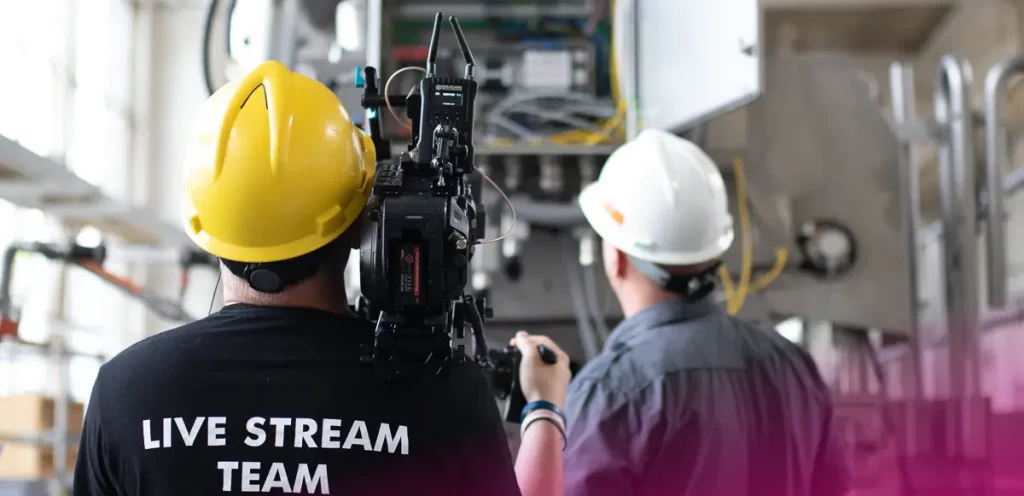
For many projects, the optimal solution is not a binary choice between Remote FAT and full delegation travel. A hybrid approach – with one or two engineers on-site to execute hands-on test steps and manage the physical test environment, while the wider FAT team participates remotely via live stream – combines the strengths of both formats.
The on-site engineer is responsible for physical execution of tests: actuating safety functions, reading gauges, verifying dimensional tolerances, and coordinating the supplier’s test team. Remote participants follow all functional sequences, review documentation in real time, contribute observations to the punch list, and participate in formal acceptance decisions. The outcome is a complete, fully traceable inspection record with multi-party involvement, achieved at significantly lower cost than full on-site attendance.
This model is particularly effective in large EPC projects with complex supplier packages; automation and robotics FATs where PLC and SCADA functional testing can be performed remotely but safety-critical functions require physical verification; and first-article inspections with new suppliers, where a single senior engineer represents the buyer on-site while broader technical and commercial stakeholders participate remotely.
8.A practical decision framework
Before selecting a FAT format, answer the following four questions:
- What does the test procedure actually require? – Review the FTP or ATP and identify every test step that requires physical intervention, calibrated measurement, or sensory assessment. If these steps are present, on-site attendance or a hybrid model is needed.
- Who needs to attend, and from where? – If sign-off requires more than two or three parties from different locations, Remote FAT or a hybrid eliminates coordination complexity and travel cost without reducing coverage.
- What is the supplier qualification context? – A new supplier on a critical system warrants an on-site visit. An established supplier on a repeat order does not require the same investment of on-site time.
- Are there facility or contractual constraints? – Confirm whether the facility permits external video transmission, whether the IT environment can support a remote session, and whether the contract specifies physical attendance as a requirement.
If the test procedure can be executed and signed off without physical intervention, and the facility and contract permit a remote session, Remote FAT is a legitimate and often superior choice. If the procedure requires hands-on steps but the stakeholder group is large and geographically distributed, a hybrid model is usually the right answer. Contact us and we will assess your specific scope and recommend a format.
9.Summary
Remote FAT is not about replacing site visits at all costs. It is about choosing the most effective inspection method for the project at hand.
For many types of FAT and SAT activities, remote inspection delivers clear advantages: faster scheduling, lower costs, easier stakeholder participation, and a complete digital record of every test performed. When supported by a structured procedure, experienced operators, and robust documentation, Remote FAT can provide the same level of confidence as traditional on-site attendance—while significantly improving efficiency.
That does not mean on-site inspections are obsolete. There are situations where physical presence remains essential: when tests require hands-on verification, when a supplier is being assessed for the first time, or when contractual and regulatory requirements demand it. In these cases, an on-site or hybrid approach remains the right choice.
The most successful projects are not defined by the inspection format they use, but by selecting the format that delivers the required level of assurance with the least disruption to schedule, budget, and resources.
Whether you are planning a FAT, SAT, supplier audit, or acceptance milestone, we can help you determine the most effective approach and design an inspection process tailored to your project’s specific requirements.