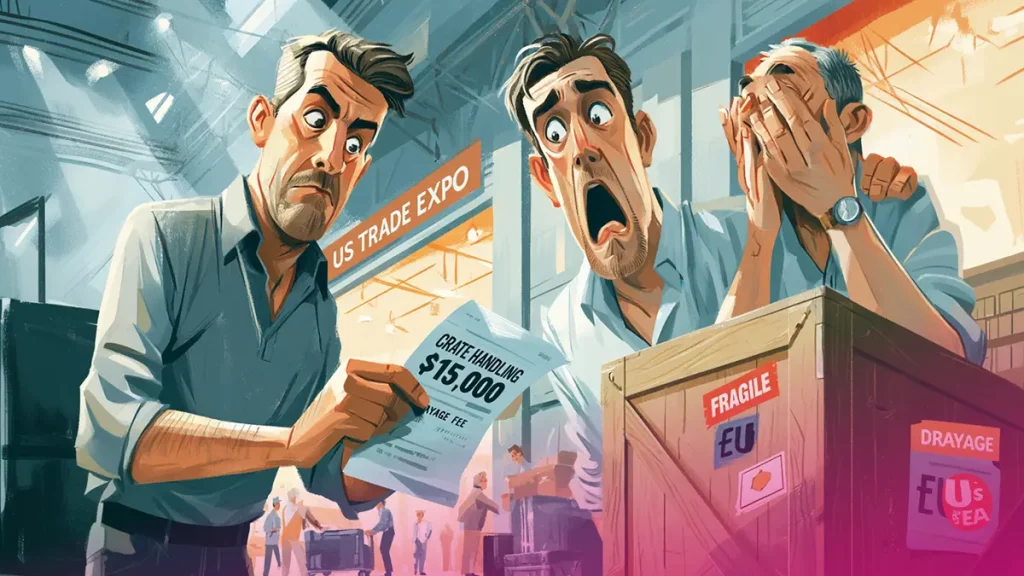
American buyers scan your booth faster, expect clearer value, and move on quickly when the message is unclear.
European companies often prepare for a U.S. trade show the same way they prepare for a show in Germany, France, Italy, or another European market. They translate the materials into English, ship a similar booth, bring the same team, and assume the conversations will follow a familiar pattern.
On the first day, a salesperson stands behind the counter and waits for visitors to come over. A U.S. buyer walks past the booth in a few seconds. At the end of the day, the team says something we have heard many times at trade shows: “The traffic was weak.”
The traffic wasn’t weak. The team just didn’t capture it.
This article is not about how to design a trade show booth or how to structure your booth team. Those are separate topics. This article is about the person walking past your booth, stopping for a few seconds, or moving on.
And it explains why an approach that works in Europe can fail in the U.S.
Short answer: what do U.S. trade show buyers expect?
A U.S. trade show buyer wants to understand three things quickly:
- what you do,
- whether you solve a problem that matters to them,
- whether the conversation can lead to a clear next step.
They will not spend much time guessing. They will not read a long explanation on your booth wall. They may not start the conversation first. And they may ask about specifics, pricing, terms, implementation, or the next step much earlier than a European exhibitor expects.
That does not make the U.S. approach better or worse. It is simply a different business rhythm.
If a European company wants to perform well at a U.S. trade show, it needs to prepare more than the booth and the materials. It needs to prepare the conversation itself: how the team opens conversations, qualifies buyers, and moves them to the next step.
1. Who is the U.S. trade show buyer?
At a U.S. trade show, the person you meet often has real influence on the buying decision.
It is not always the owner or the CEO. More often, it is:
- a sales director,
- a procurement manager,
- a technical specialist,
- a product manager,
- a distributor,
- a manager preparing a supplier recommendation,
- someone who will later take the recommendation to leadership.
That matters because each of these people is looking for something different.
A sales director wants to know whether your solution can improve results. A technical person wants to understand how the product works and whether it can be implemented. A distributor is thinking about whether they can sell it in their market. Procurement is looking at scale, terms, risk, and supplier credibility.
If your booth message is too generic, it does not speak to any of them.
A slogan like “innovative solutions for your business” does not help anyone make a decision. It does not even say whether you are a software provider, a component manufacturer, a technology company, or a logistics partner.
The visitor has to guess. At a U.S. trade show, most people will not spend time guessing.
If they cannot quickly understand what you do and why they should stop, they will usually move on.
2. What do U.S. trade show buyers expect?
A U.S. buyer expects two things: quick understanding and a concrete conversation.
This is not about aggressive selling. It is about not wasting the time of a person who is walking through a busy hall with meetings on the calendar, companies to compare, and a limited amount of attention.
Understanding in 3 to 5 seconds
A U.S. buyer should understand what you do and whether it is worth stopping in 3 to 5 seconds.
They do not need to understand your entire offer immediately. They need to know whether they are in the right place.
That leads to a simple rule: category first, benefit second.
If you are a software company, the visitor should quickly understand whether you sell price management software, a logistics platform, a data analytics tool, or an e-commerce solution.
If you work in manufacturing or industrial technology, they should understand whether you are talking about production-line robots, machine components, quality control, or maintenance services.
Only then does it make sense to talk about features, advantages, and details.
First, the buyer needs to know whether the topic is relevant at all.
One of the most common mistakes European exhibitors make is assuming that everyone already understands their category, industry language, and context.
They do not.
Good booth communication should be readable from the aisle and answer three questions:
- what it is,
- who it is for,
- what problem it solves.
At highly specialized shows, the audience may understand the category better, and your message can be more technical. But at events where different industries, technologies, and levels of awareness mix together, a simple message visible from the aisle becomes critical.
Pricing comes up earlier than many European teams expect
U.S. buyers often bring pricing into the conversation earlier and more directly.
For many European companies, this can feel uncomfortable because price is often discussed later or more carefully in Europe.
In the U.S., a vague “please contact us for a quote” can sound like avoidance.
A number, a price range, or a clear explanation of what drives the price shows that you are taking the conversation seriously.
There is another important point: send someone who can make decisions or at least clearly define the terms of the next step.
In many U.S. companies, a mid-level manager may already have real influence over budget, supplier selection, and the next stage of the process. That person expects to speak with someone who does not need to check every number with headquarters.
We have seen this many times. After a strong conversation, a U.S. director may openly say they are unsure whether they can work with a company whose representative is not ready to discuss a decision worth one or two million dollars, even if that representative is formally authorized to be there.
For the U.S. side, this is not a small organizational detail. It is a signal.
It tells them whether your company is ready to operate in a market where decisions of that size can move faster and lower in the organization than many European companies expect.
The conclusion is simple: if the person at the booth needs to check every number with headquarters, the conversation loses momentum.
A buyer who has budget and wants to move now will go where they can get a clear answer faster.

3. How is a U.S. trade show conversation different from a European one?
The biggest difference is pace.
In the U.S., conversations often get to the point faster. In Europe, the conversation may start with a longer introduction, company background, and relationship-building context.
Relationships matter in the U.S. too. They are just often built differently.
They often start with a useful, concrete conversation:
- what you do,
- who you help,
- what problem you solve,
- whether there is a reason to continue talking.
That is not being pushy. It is a different business conversation style.
In practice, the first step often belongs to the booth team, not the visitor.
The team needs to approach, introduce the company briefly, and quickly find out whether the topic is relevant to that person.
This is not about delivering a memorized pitch. It is about starting a conversation that qualifies the visitor:
- who they are,
- what they are looking for,
- whether they have a problem you can solve,
- whether it makes sense to move to a demo, technical discussion, or budget conversation.
The booth wall and the first conversation have different jobs.
The wall has 3 to 5 seconds to capture attention. The first conversation has to find out whether that attention has real business potential.
If you copy the European approach directly and wait for the visitor to start the conversation, you may waste a strong opportunity, even if the booth itself is well designed.
4. “The traffic was weak” - was it really?
Those few seconds when someone walks past your booth are not dead time.
The visitor is already sending signals. Your team needs to notice them.
They slow down. They look at the screen. They read the headline twice. They glance at the materials but do not pick them up. They take half a step toward the booth and hesitate.
That is an invitation. Just a quiet one.
This is where many European companies are surprised by a cultural difference.
In the U.S., service, openness, and a friendly approach are part of normal business communication. In a U.S. store, it is normal for someone to approach you, ask if they can help, and do it with a smile. At a trade show, a similar logic applies.
Approaching someone is not pushy if it is done naturally and with good timing.
It is often perceived as good service.
A serious, closed tone that may feel neutral in Europe can easily come across as cold or uninterested at a U.S. booth.
That is why the booth team’s role is not to guard the booth.
It is to notice interest and respond before the visitor moves on.
A person who guards the booth waits for the visitor to speak first. A person who works the trade show floor sees the moment of hesitation and starts the conversation.
The first sentence can be warm and simple, even “Can I help you?”
But it cannot stop there.
The team needs to move quickly into something more concrete: the category, the problem, or the visitor’s need. That is how a glance at a screen becomes a qualified conversation instead of another person walking away.
5. U.S. vs. Europe: key differences in approach
The differences below are not a judgment about which market is better. They are a map of behaviors your preparation needs to match.

USA
- Gets to business faster
- More direct in conversation
- Brings up money earlier
- Greater comfort with clear commitments
- Actively captures interest at the booth

EUROPE
- Builds context longer
- More indirect, cautious conversation style
- Price often comes up later
- Decisions often develop through a longer process
- More often waits for visitor initiative
For a European company, the main point is simple:
you do not need to pretend to be an American company. You need to understand how the American buyer scans the booth, starts a conversation, and makes decisions.

Not sure if your team is ready for a U.S. trade show?
We’ll review your booth message, sales approach, and follow-up plan before you invest in the show.
Book a free consultation with EventGuru – click the button and ask us anything.
6. What happens after the first contact?
The first contact is not the goal.
It is the moment when you need to understand whether the visitor’s interest has business potential and what should happen next.
There is no single script for every company. You will handle a software product differently than a machine, an industrial component, or a service.
But the principle is the same: a visitor who stops at your booth should not leave with only a brochure and a vague promise that “we will follow up after the show.”
Let’s assume the first contact has happened and the team has captured the visitor’s interest. What comes next?
1. Qualify the visitor
After the first contact, you need to quickly understand whether you are speaking with a real sales lead, a future buyer, or someone for whom your solution simply does not make sense.
In simple terms, there are three situations:
- If this is not the right buyer, be honest. If you can, point them toward a simpler or better-fit solution.
- If this may be a buyer, but not yet, the reason may be scale, budget, or organizational readiness. Explain when the topic may make sense and what they should come back with.
- If this is a conversation with potential, direct the visitor to the right next step: a demo, technical discussion, budget conversation, or specific follow-up.
In each case, the person should leave with something concrete: clear information about what happens next or material that fits their problem.
Not every contact is a lead today, but every contact can build trust that may come back later.
2. Capture the context
After the show, a name and company are not enough.
Write down:
- what the conversation was about,
- what problem the visitor had,
- what you promised to send,
- what next step was agreed,
- who on your team should continue the conversation.
Without this, the follow-up becomes generic. And a generic follow-up makes the trade show conversation look like it did not matter.
3. Follow up before the conversation goes cold
After the show, the buyer quickly returns to their daily work.
A message sent a week later often arrives too late: the conversation has lost momentum, a competitor has already followed up, and the buyer no longer remembers the details.
A good follow-up goes out within 24 to 48 hours.
It should:
- refer to the actual conversation,
- come back to the buyer’s problem,
- remind them of the context,
- clearly show what should happen next.
In practice, your booth should work like a path, not a decoration: attract the right buyer, help the team qualify them quickly, and move them toward a demo, discussion, or next step.
Booth layout and visitor flow deserve a separate article. So do booth team roles, demos, and follow-up. The point here is simpler: the first contact only matters if the next step is clear.
7. When does a U.S. trade show make sense, and when should you pause?
Exhibiting in the U.S. makes sense when your company knows why it is going, who it wants to reach, and what value it needs to show that buyer from the first seconds.
“We want to be visible in the U.S. market” is not enough.
Neither is shipping your European booth and team over unchanged.
For the U.S. market, you need to prepare the way you speak with the buyer:
- a clear message,
- concrete value,
- people ready for conversations,
- a plan for what happens after the first contact,
- a follow-up process that does not start a week later with a generic email.
We often tell clients one thing:
If you want to succeed in another market, understand it first instead of judging it through your own habits.
Before signing an agreement with the show organizer, ask a few simple questions:
- Do we know who should stop at our booth?
- Will that person understand our offer without a long explanation?
- Can we show real value instead of only talking about our company?
- Do we have a team that can take over the conversation and move it forward?
- Do we know what happens to the contact after the show?
- Can we discuss budget, terms, and the next step without pushing everything “to later”?
If the answer is no, it does not mean you should cancel the trade show.
It means you should improve the preparation before committing the budget.
Sometimes that means refining the message. Sometimes it means training the team. Sometimes it means adjusting the scale of your presence or testing your assumptions with someone who knows how U.S. trade shows actually work.
A successful U.S. trade show does not start with booking booth space.
It starts with understanding the buyer, the market, and how to show value in conversation.
Without that, the budget may end with a nice booth photo, a few conversations that go nowhere, and the conclusion that “the trade show did not work,” even though the real problem was preparation.
Summary: how should a European company prepare for U.S. trade show buyers?
Before you commit to a U.S. trade show, check whether:
- your booth message is clear within a few seconds,
- you show the category and the problem you solve immediately,
- your team can actively start conversations,
- someone at the booth is ready to discuss specifics,
- the next step after first contact is clear,
- follow-up goes out within 24 to 48 hours,
- the trade show has a clear business goal, not only a visibility goal.
A U.S. trade show can be a strong step in international expansion.
But not if the company arrives with a translated brochure, a familiar booth, and the hope that conversations will happen on their own.
Check whether your company is ready for a U.S. trade show
If you are planning your first U.S. trade show, or you want to know whether your current preparation is strong enough, download the checklist.
It includes 37 questions to review with your team before you book the booth, send people on site, and commit the budget. Use it to review your message, booth team, conversation plan, follow-up process, and key operational risks.
Download the checklist
See whether your company is ready for a U.S. trade show.
Planning your first U.S. trade show and not sure whether your company is ready? Start by checking whether your booth reads clearly and your team can turn interest into a real conversation, before you commit the budget to booth production, travel, and show services.
Let’s talk. We’ll check whether your message, team, and follow-up plan are ready for how U.S. trade show buyers actually behave.