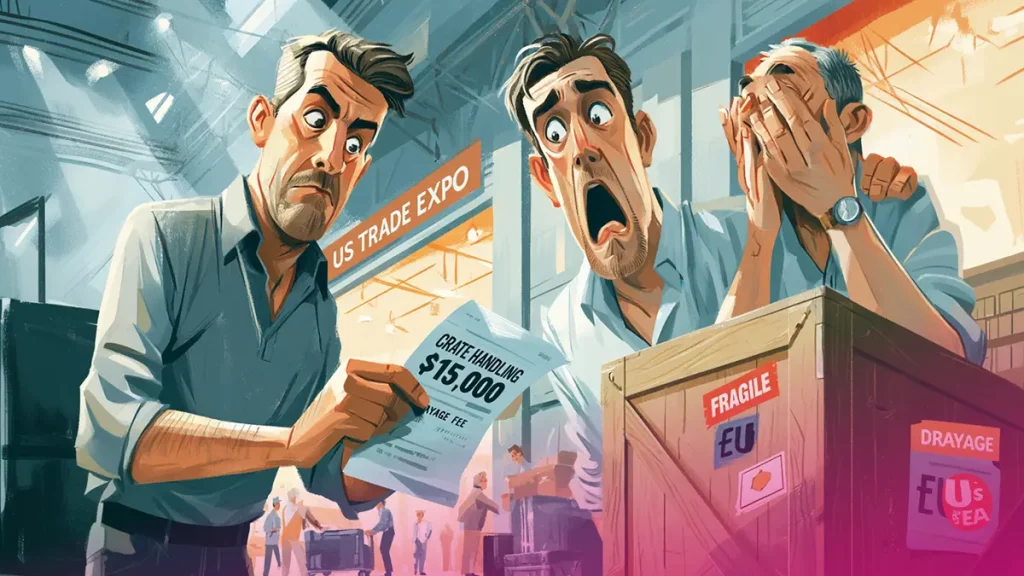
European companies often show up to a U.S. trade show running the same playbook they use back home.
The trouble usually starts on site, once payment terms, install rules, freight handling, labor, and technical services all play out differently than they do in Europe.
The local crew may not know your booth system. They may not have the right tools to build it. Your crates can land at the hotel or convention center dock, and getting them from the dock to your booth space can still run several thousand dollars. An electrician may not turn the power on until someone on site pays with a card.
Then there’s the small stuff that’s easy to sort out in Europe: carpet, furniture, a screen, a TV stand, an extension cord, bubble wrap to repack the booth after the show. In the U.S., leave those calls for move-in or move-out and you can end up paying a fortune for something that looks worse than you pictured.
The core mistake is simple: you bring a European playbook to a U.S. show floor, and the two don’t run the same way.
Labor rules, payment expectations, and how much you can improvise on site all look different in the U.S.
That’s where most of these mistakes start: with the assumption that the rules will feel familiar.
This comes from more than ten years of working trade shows and events, including projects in the U.S. I’ve run into these problems during move-in, at the dock, at the booth, and in conversations with electricians, local crews, venue teams, suppliers, and clients.
This article walks through seven places where European companies most often lose time, money, and control.
Quick answer: where do European companies most often lose control at U.S. trade shows?
It’s not that U.S. trade shows are impossible, or harder by nature.
It’s that they run on a different set of rules.
The table below is a quick reference: the seven mistakes, the assumption behind each one, and what can go wrong. I break each one down in more detail below.
Know the rules early and you can plan around them. Find out during move-in and you’re making calls under pressure, at the booth, with a crew waiting on you, or with a supplier telling you nothing moves until you pay.
The organizer’s process won’t bend around the way your company works in Europe. Your plan, budget, booth design, and logistics have to fit the show’s rules.
| Mistake | Wrong assumption | What can go wrong |
|---|---|---|
| Using a European budget model | “We've paid for the exhibit space, so we're covered” | You miss what's billed separately in the U.S.: power, internet, unloading, getting crates to your space, install, and late orders |
| Designing before you read the manual | “The design's done” | The organizer can make you change it on site: drop a wall, pull a structure, move a piece, or bring it in line with the show rules |
| A local crew with no supervisor | “They'll give us a good crew and it'll go up fine” | The crew may not know your system, may not have the right tools, or may try to piece it together by trial and error. You lose time, pay for extra hours, or have to bring in more people |
| Treating delivery as the end of on-site logistics | “The shipment arrived, so logistics are handled” | Your carrier can stop at the dock gate. Getting crates from the dock to your space, unloading, and empty-crate storage can still run several thousand dollars |
| Leaving the small stuff for later | “If we're short something, we'll buy or rent it there” | On move-in day your options are thin, prices are high, and quality's often worse than you expect. You can pay a lot for something that looks cheap |
| Planning to pay later | “If something comes up, they'll just invoice us” | Payment's often due on the spot. If nobody has a card, enough available credit, and approval, power or another service may not start |
| Salespeople with no authority | “Sales will grab leads and we'll decide after the show” | A prospect may want to work contract details on site: price, scope, timing. If no one at the booth can talk terms or move the conversation forward, the opportunity can stall |
Why your European trade show plan may not work in the U.S.
In the U.S., a lot of things are billed separately.
Buying exhibit space doesn’t automatically include power, internet, installation, freight handling, getting crates to your booth, empty-crate storage, or technical services.
Some things you have to order ahead. Some can only be done by an official provider. Some cost more once the deadline passes. Some won’t start until you pay.
That can throw a European company, because back home there’s usually more room for last-minute fixes: talk to someone on site, borrow something, grab it fast, pull it from a nearby supplier, or tweak a detail during install.
In the U.S. you can still do that sometimes. It’s just usually pricier, more formal, and less flexible.
So before you travel, check the things that look secondary at first:
- whether the booth meets the organizer’s exhibitor manual,
- whether power and internet are included or have to be ordered separately,
- who’s allowed to build your booth,
- whether the local crew knows your system,
- whether your crates go straight to your booth space or first to a dock,
- how much it costs to move crates from the dock to the booth,
- who has a card with enough available credit to pay on site,
- whether someone at the booth can make a real commercial or financial call.
These aren’t questions to leave for move-in.
Skip them before the trip and you end up hunting for answers during move-in. By then you’re not picking the best option. You’re picking whatever can still happen right now.
And that’s usually when you pay the most: in money, stress, and time.
Mistake 1. You build the U.S. budget like a European one
In Europe, the budget usually starts with the biggest visible items: space, booth, shipping, hotel, flights.
That makes sense.
The problem is that in the U.S., that budget can be incomplete from day one.
Not because anyone’s out to surprise you. It’s just that a lot of things that feel included, or easy to arrange, or cheap to handle on site in Europe can be separate paid services in the U.S.
That can add:
- power,
- internet,
- unloading,
- moving crates from the dock to the booth,
- empty-crate storage,
- installation,
- extra labor hours,
- technical services,
- orders placed after the deadline,
- payments due before work starts.
Each one can look small on its own. Together, they can move the whole budget.
I’ve seen projects where the biggest surprise wasn’t the booth itself, it was the costs around it: power, extra install hours, moving crates, storing empties, or one simple thing ordered too late.
I break the ranges and examples down in a separate article on U.S. trade show costs.
The worst time to find out about these costs is when the team’s already on site, with no time to sit and weigh your options.
What should you add to the budget?
Don’t approve a U.S. trade show budget that only covers space, booth, shipping, hotel, and flights.
Add every service that might be billed on top, especially:
- power,
- internet,
- unloading,
- moving crates to the booth,
- installation,
- empty-crate storage,
- extra labor hours,
- late orders.
Don’t leave these as “TBD” if they can move the budget.
Nail them down before you approve the booth design and before you ship the booth to the U.S.
Mistake 2. You design the booth before you read the exhibitor manual
This is one of the most expensive mistakes, because it usually surfaces only after the booth’s already built and shipped.
Someone designs the booth. It looks good. The client signs off. It goes into production. Then it ships to the U.S.
And on site, one piece doesn’t meet the organizer’s rules.
Say a side wall’s too tall and blocks the neighbor. Or a piece runs past your boundary. Or the build doesn’t hold the required setback. Or the height goes over what the manual allows.
At that point the organizer, the technical manager, or whoever owns show-floor rules can make you cut it down, move it, pull it, or rebuild part of the booth.
And that’s on you.
It won’t matter that the booth’s already built, that it looked fine in the rendering, or that the same setup passed in Europe.
In the U.S., the exhibitor manual sets the rules for that show. If your booth doesn’t meet them, you can pay for changes, extra labor, a partial tear-down, or emergency fixes on site.
What should you check before you build the booth?
Before you approve the design and send it into production, read the organizer’s exhibitor manual.
Not in general. Specifically:
- what type of booth space you have,
- the maximum allowed height,
- limits on side walls,
- required setback from the neighbors,
- whether your build blocks nearby exhibitors,
- where taller pieces can go,
- where screens can go,
- where the power access is,
- who’s allowed to do the install,
- which parts need organizer sign-off,
- every submission and order deadline.
Only then approve the design and build the booth.
A good U.S. booth design has to look great and still clear the organizer’s rules, so nobody makes you change it during or after install.
Mistake 3. You assume a “good local crew” is enough
In the U.S., you’ll often hear the crew is great, experienced, perfect for the job.
Sometimes you’ll hear you’re getting the best crew available.
That’s normal. Nobody’s going to tell you they’re handing you an average crew.
But a confident promise doesn’t mean the crew knows your booth system.
I’ve been told plenty of times I was getting the best team on site. Then the crew didn’t have the tools, didn’t know the system, didn’t get the install sequence, or couldn’t connect parts any experienced European crew would find obvious.
Most of the time it’s not bad intentions. It’s a different division of labor.
In the U.S., people are often narrowly specialized. One person or crew handles structure. Another handles electrical. Another handles decor. Another handles graphics. Another handles a specific part of the install. What one seasoned European crew does together can be split across several trades in the U.S.
That’s why you might hear: “we don’t do that,” “that’s a different crew,” “we can’t touch electrical,” or “a decorator has to set that graphic.”
If your booth is custom, unusual, or built in Europe, don’t assume the local crew will just figure it out.
They may go by trial and error. They may put parts together wrong. They may tape something instead of using the right screws. They may turn down a simple-looking task because it’s outside their scope.
I’ve watched installs bleed time and money this way. With U.S. trade show labor, every extra hour hurts. In union or specialty settings, $250 to $350 an hour isn’t unusual. And you might be paying that for people who don’t know your system or don’t have the tools to build it.
How do you keep a local install from going sideways?
If you’re shipping a booth from Europe, or using a system the local crew doesn’t know, plan for a supervisor.
The supervisor doesn’t have to build the whole booth themselves. A lot of the time they shouldn’t, or can’t, do the work that belongs to local labor. Their job is different.
They need to know the booth cold.
They need to know:
- what connects to what,
- the order of assembly,
- which parts are fragile,
- where the critical points are,
- which tools you need,
- when to call off a bad approach,
- who to talk to when the crew isn’t working to plan.
Chain of command matters in the U.S. too. When something goes wrong, you usually don’t fix it by pulling aside every person on the crew. You take it to the foreman, supervisor, or crew lead. That’s who you work out timing, problems, and fixes with.
On bigger or more complex custom builds, one supervisor may not cut it. It depends on the project.
Put together a clear build guide, too. Ideally with photos, numbered parts, and a step-by-step order.
A guide helps when everything goes to plan. But if a part’s missing, the crew doesn’t get the system, or something doesn’t fit, the guide alone won’t cut it.
Then you need someone on site who can actually run the install.
Bring spare small parts, too: screws, nuts, connectors, bits, adapters, anything that fits your system.
If the booth’s built in Europe, don’t assume the local crew will have matching parts on hand. Thread sizes, measurements, standards, and tools can all differ. One missing bolt can stall the whole install way longer than it should.
Mistake 4. . You treat delivery as the end of on-site logistics
Getting your booth shipment to the venue isn’t the same as getting it to your booth space.
This is where a lot of European companies miss a critical part of the process.
Your carrier can drop the shipment at the venue, but that doesn’t mean the driver’s allowed onto the dock, cleared to unload, allowed to leave the crates, or able to move them to your space.
The dock can have its own schedule, receiving rules, forms, labels, order numbers, and fees. Skip that ahead of time and the truck can be at the venue while your crates still aren’t at your booth space.
Your carrier’s job can end at the dock gate. Everything past that point can be the official show contractor’s job.
How you pack can bite you, too. If crates are poorly built, a pallet jack can’t get under them, they’re too heavy or too wide, or they won’t fit through doors, elevators, or freight corridors, unloading and getting them to your booth space gets a lot harder.
Someone has to take delivery, unload the crates, move them from the dock to your space, haul the empties away, store them through the show, and bring them back afterward.
You can get billed for every one of those steps.
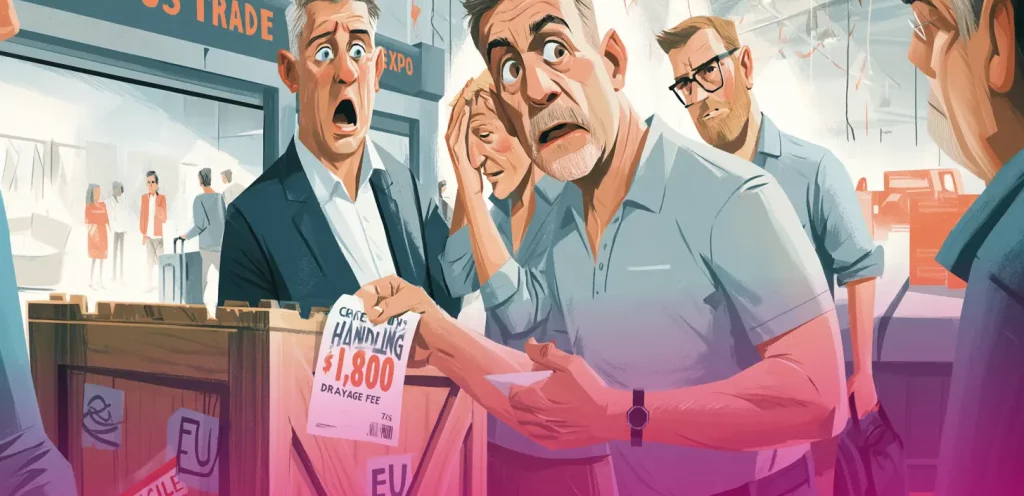
On a heavy booth, I’ve seen $7,000, $8,000, even $9,000 just to move the crates from the hotel dock to the floor.
Those numbers usually come from material handling, weight, timing, dock operations, and show rules. I explain where they come from and how to check them before the trip in a separate article on U.S. trade show costs.
For a European company it’s a shock: the shipment’s physically at the venue, but it still has to clear dock rules, unloading, material handling, and the haul to your space.
The worst time to learn this is move-in day.
Skip confirming unloading, dock scheduling, and fees, and it blows up on move-in day. You might not be on the schedule, the dock team might not get to your delivery right away, or the next available slot may come later at a much higher rate. And if nobody has a card with enough available credit, your booth might just not make it to the floor on time.
Not knowing this part of the logistics can get expensive.
What should you confirm before you ship the booth?
Before you ship to the U.S., pin down:
- whether your freight goes straight to your booth space,
- or first to a hotel dock, convention center dock, or advance warehouse,
- whether your carrier’s allowed onto the dock,
- whether the delivery has to be scheduled ahead,
- whether you’re on the unloading schedule,
- who takes delivery on site,
- who handles the unloading,
- who moves the crates from the dock to your space,
- whether your crate sizes and packing fit the dock, doors, elevators, freight corridors, and unloading gear,
- what the service costs,
- whether the cost’s based on weight,
- how much all the crates weigh,
- what happens to the empties during the show,
- what storage costs,
- when you have to order it,
- what it costs after the deadline.
You can cut some of this ahead of time. Pack the booth differently, use fewer crates, drop weight, or decide some pieces are better bought or rented in the U.S.
But to make that call, you need the dock rules, the unloading rules, and how things get to your space before you ship, not once the truck’s already at the venue.
Mistake 5. You leave the small stuff until the last minute
In Europe, a lot of last-minute problems can still be fixed.
Short a cable, a monitor, a chair, a table, a lamp, a carpet? Someone drives out, buys it, borrows it, brings it in.
In the U.S. you can sometimes buy or rent on site too. But on move-in day your options are thin, prices are high, and you’re out of time.
Then there’s quality.
Whatever you can get quickly on site may not match what a European company expects. You can pay a lot for carpet, furniture, a TV stand, or a basic piece of gear that looks cheap and wouldn’t pass back home.
That’s the painful part: you pay a lot, and it still doesn’t look right.
I once paid about $1,100 for a thin carpet on a small 10×20 ft space, roughly 18.5 m². It was the cheapest one they had, thin as paper, and looked like it was worth a fraction of that. But on move-in day, there was nothing else left.
Same thing with furniture, TVs, TV stands, extension cords, small technical parts, or packing materials.
I’ve paid a few hundred dollars more than once for plain bubble wrap, just to repack a booth during move-out.
So this one isn’t only about move-in. It’s about move-out and packing after the show, too.
If you don’t plan how the booth gets built, protected, taken down, and packed, the back end of the show can run up costs too.
What gets expensive if you leave it for later?
Before the trip, build a full checklist for move-in, running the booth, and move-out.
Check, for example:
- carpet or flooring,
- furniture,
- screen,
- TV stand,
- extension cords,
- small technical parts,
- basic tools,
- spare screws and connectors,
- adapters and parts that fit your system,
- gear for quick fixes,
- packing materials for move-out,
- bubble wrap,
- tape,
- crate labels,
- how the booth parts get protected after the show.
For each one, decide early: bring it, buy it local, rent it, or order it through the official provider.
It also helps to know what this stuff costs in the U.S. so you’re not blindsided on site.
Don’t let this sit in the plan as “we’ll figure it out on site.”
By move-in or move-out, it’s usually too late for a good price, a good option, or good quality.

Planning a U.S. trade show?
We can help you review the booth plan, budget, logistics, local labor, technical services, and follow-up before expensive surprises show up on site.
Click the button, fill out the contact form, and we’ll get back to you quickly.
Mistake 6. You assume you can pay later
A lot of European companies are used to invoices, bank transfers, and settling the bill after the event.
At U.S. shows, the order can flip: payment first, service second.
That goes for technical services, power, internet, add-on orders, labor, and anything you set up during move-in.
Power’s a good example.
In Europe there’s usually an outlet at the booth, the crew plugs in an extension cord, and you’re done.
In the U.S. it can work differently.
Sometimes only a licensed electrician can plug an extension cord into the outlet at your booth. You can have your own cord. You can see the outlet. But you’re officially not allowed to plug it in yourself.
You may have to order the right amount of power, fill out a form, pay for it, and wait for the person who’s cleared to hook it up.
Prices swing a lot by city, state, hotel, convention center, how much power you need, and local rules. Atlanta can look nothing like San Francisco, Las Vegas, or a hotel event with specific union agreements.
If you’re running big LED screens, heavy booth lighting, or a lot of devices, plan the power early. Last minute, it gets very expensive, or flat-out impossible.
I’ve got a very specific memory from one of my first U.S. projects. An electrician showed up with his own cord, told us to unplug ours, and said only he could hook up the right one. It cost a lot. The person holding the client’s credit card had just left. The electrician didn’t care that someone would be back in an hour or two. No payment, no power.
It was stressful, because we still had to test the booth lighting and finish the build. The room manager summed it up in one line: “Welcome to America.”
I’m not telling you this to scare you. I’m telling you so you’re not caught off guard the way I was that day.
These days some of this can go differently: by invoice, through an ordering portal, prepay, or deferred billing. But don’t assume it.
Check ahead of time.
How do you keep payment from stalling you?
Before move-in, nail down who has a card, what the available credit is, and who can approve an extra cost.
Also sort out:
- whether your agency can pay on the client’s behalf,
- up to what amount,
- which services have to be paid upfront,
- which can be billed after the event,
- where order confirmations are stored,
- where order numbers and supplier contacts are stored.
Pay for as much as you can before move-in.
And if something has to be paid on site, decide up front who approves it and how you’ll pay. Don’t go hunting for that person at the booth while the crew’s standing around, the screen’s dead, and the electrician says nothing happens without payment.
Mistake 7. You send salespeople without the authority to make a deal
The last mistake is a sales mistake, and I think it’s one of the biggest.
In the U.S., trade shows can turn into serious business conversations fast. A prospect may want to talk terms, scope, price, timing, a pilot, a rollout, or even start moving toward a signature.
If your booth team can only “grab the lead” and “send it back to HQ,” you can lose a great shot.
In my experience, bigger decisions in Europe usually run through the board, HQ, a formal process, and a few approval layers. In the U.S., I’ve more often met managers or senior managers with more authority to decide than a European exhibitor would expect.
That doesn’t mean everyone signs on the spot. But the conversation can get into numbers, scope, commitments, and next steps fast.
I’ve watched a prospect struggle to understand why a serious contract conversation couldn’t go anywhere with the person standing right at the booth. They were ready to talk specifics. We had no one there who could make the call; the decision sat back at a European HQ.
And that’s when the momentum dies.
After the show, the prospect has more meetings, more offers, more priorities. What could’ve moved on the show floor starts to drag.
In the U.S., speed, clarity, and service matter a lot. If a prospect feels like they have to wait, re-explain everything, or grind through approval layers, interest fades fast.
Who can talk price and terms at the booth?
Send people who can actually talk business terms.
It doesn’t have to be the CEO. But it has to be someone who knows the negotiating limits and knows:
- what offer they can put on the table,
- where they can be flexible,
- what they can’t promise,
- who signs off on the final terms,
- how long sign-off takes,
- when they can commit,
- when the right answer is “this needs confirmation,”
- how fast they can come back with a real answer.
If the call has to happen at HQ, set up a fast approval path before the show.
Not after. Before.
Follow-up still matters, too. If the conversation got specific, the follow-up can’t be a generic “great to meet you at the show” email.
Your reps should write down:
- who they talked to,
- what it was about,
- what problem the prospect had,
- what decision they’re waiting on,
- what you promised to send,
- who’s coming back with an answer,
- and when.
Follow-up should pick the conversation back up, not start it over from scratch.
How to check your plan before a U.S. trade show
Before you exhibit in the U.S., run through the areas that cause the most expensive surprises:
- budget and the costs that get billed separately,
- exhibitor manual,
- booth design,
- local install and supervision,
- freight, dock access, and crate handling,
- power and technical services,
- on-site payments,
- who can make decisions at the booth,
- follow-up after sales conversations.
We put together a downloadable checklist so you can review these points before you approve the budget, the booth design, and the shipment.
Download the checklist: What to Check Before Your U.S. Trade Show

FAQ
Najczęstsze pytania klientów
Are U.S. trade shows always harder than European ones?
Not always.
They’re just different.
In the U.S., more gets billed separately, ordered earlier, and handled more formally. Know those rules before you go and you can plan around them. Find out during move-in and it usually gets pricier and more stressful.
Is it worth shipping your own booth from Europe to the U.S.?
Sometimes, yes.
It makes sense if the booth’s proven, well packed, fairly light, and someone on site knows how to build it.
But don’t make that call just because “we already own the booth.” You have to add up freight, crate weight, material handling, install, damage risk, and the cost of supervision.
It’s also worth checking whether it’s smarter to simplify the build, rent some pieces locally, or order certain items in the U.S. ahead of time.
Is it better to rent everything locally in the U.S.?
Not always.
Renting local can simplify the logistics, but it can also be pricey, thin on options, and lower quality than you’d expect.
There’s no single rule. You check it item by item: what to bring, what to buy, what to rent, and what to order through the official provider.
Does local or union labor always mean trouble?
No.
The problem isn’t the local crew. The problem is being unprepared.
If the crew knows the system, has a clear guide, has the right tools, and has someone who knows the booth running point, the risk drops.
Assume “they’ll figure it out” and you’re risking delays, extra people, extra hours, and higher costs.
Do we really need someone with decision-making authority at the booth?
Not for every show.
But if you’re at a U.S. show for serious business development, someone at the booth should be able to make a real commercial call, or trigger one fast.
Trade shows aren’t just about collecting business cards. Sometimes the best conversation happens right there on the floor. If no one can take it to the next step, the opportunity fades.
Does follow-up after the show really matter that much?
Yes.
Especially in the U.S., where a quick response and good service go a long way. If a conversation got specific and the prospect gets a generic email afterward, it can feel like they weren’t taken seriously.
That’s why you capture the context of each conversation at the booth, and sort out who owns follow-up before the show.