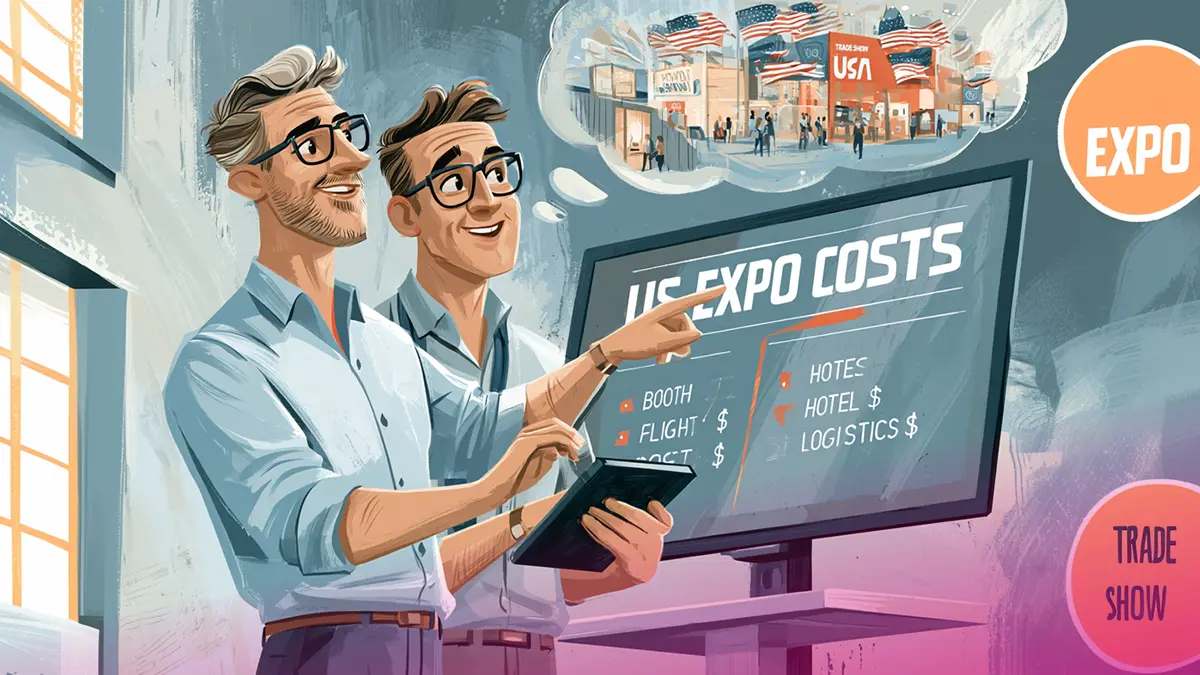
You have the booth space. You have the first booth estimate. You add shipping, hotels and flights. The spreadsheet looks under control.
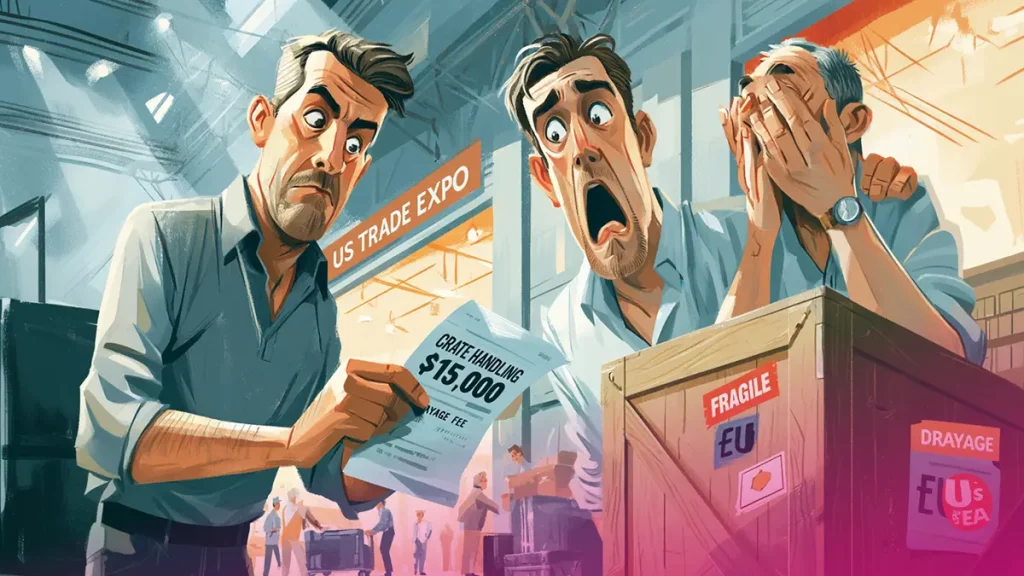
Then the team arrives in Las Vegas, Chicago, Miami or another U.S. venue, and the missing costs start to appear: material handling, power, internet, labor, insurance, on-site card payments, late fees and services that were never included in the first booth estimate.
This is no accident. It is a common scenario for European companies that plan a U.S. trade show the same way they plan Hannover, Milan or Paris.
So how much does it cost to exhibit at a trade show in the U.S.? A single number would be convenient, but it would be misleading. There is one rule that protects the budget:
booth cost is the beginning, not the total.
In our experience, a U.S. trade show budget can land roughly 30 to 50 percent above the original plan when the company misses the services around the booth. Treat this as a pattern we have seen in projects, not as a rule for every show.
This article shows what usually sits inside a U.S. trade show budget, where European exhibitors tend to underestimate costs, and what to check before you place the first order.
At the end, you will also find a short glossary of U.S. exhibitor manual terms: drayage, CWT, advance rate, floor rate, COI, additional insured, payment authority and other terms that often affect the budget.
There is also a downloadable checklist: “What to check before you order a booth for a U.S. trade show.” It is the practical version of the same budget review you can use before talking to the organizer, booth builder or sales team.
1. The real cost starts after the booth estimate
The booth estimate is usually the first number you see. It is rarely the full budget.
What you actually pay depends on the city, venue, show, booth size, booth standard and technical services. That is why the useful answer is a range, not one number.
As a rough planning benchmark, booth construction in the U.S. is often discussed in a range from about $140 to more than $400 per square foot. For a 10×20 ft booth, that gives a working range of roughly $28,000 to $80,000. For a 20×20 ft booth, the same calculation means roughly $56,000 to $160,000.
These are scale numbers, not a ready-made price list.
The real budget begins in the exhibitor manual: order forms, deadlines, technical fees and venue rules for the specific show.
Booth space and construction are often only part of the full cost. The rest can sit in separate lines: drayage, material handling, union labor, power, internet, AV, insurance, sales tax, customs, travel, accommodation and your team’s time.
In the U.S., each of these items can be a separate cost, a separate form and a separate payment deadline. That is why the first estimate can be dangerous. It shows the most visible cost, not always the cost that hurts most.
You can predict this budget if you start with the physical reality of the booth: everything that enters the hall and everything that must be ordered on site.
How to convert booth sizes: feet, meters and the planning range
U.S. booth sizes are usually listed in feet. For a European team, it helps to convert them into meters and square footage immediately, because most booth construction benchmarks are based on square feet.
The conversion is simple: 1 foot is 30.48 cm, and 1 square foot is about 0.093 m². If you use a working range of $140-$400 per square foot, you get a quick sense of the scale of the booth construction budget.
| Booth size | Area | Approx. size in meters | Booth build at $140/sq ft | Booth build at $400/sq ft |
|---|---|---|---|---|
| 10x10 ft | 100 sq ft | about 3.05 x 3.05 m | $14,000 | $40,000 |
| 10x20 ft | 200 sq ft | about 3.05 x 6.10 m | $28,000 | $80,000 |
| 20x20 ft | 400 sq ft | about 6.10 x 6.10 m | $56,000 | $160,000 |
| 20x30 ft | 600 sq ft | about 6.10 x 9.14 m | $84,000 | $240,000 |
This is still only booth construction. A full event budget also needs booth space from the organizer, drayage, labor, power, internet, AV, insurance, sales tax, shipping, team travel and sales activity around the show.

Not sure if your team is ready for a U.S. trade show?
We’ll review your booth message, sales approach, and follow-up plan before you invest in the show.
Book a free consultation with EventGuru – click the button and ask us anything.
2. A note on prices and fees in this article
Treat the amounts in this article as planning references, not as a price list. In the U.S., trade show service costs can vary by city, venue and show.
Fees for ESTA, visas, ATA Carnet, COI, drayage, power, internet, labor, lead retrieval and official contractor services can change. Sometimes once a year. Sometimes faster.
Use the numbers here to understand the scale and structure of the budget. Before you make decisions, confirm current fees in the exhibitor manual, with the show organizer, with the official contractor, with the chamber issuing the ATA Carnet, or with a tax or immigration advisor when the topic requires it.
Instead of memorizing individual prices such as ESTA or scanner fees, remember the mechanism: in the U.S., budgets usually go over because of many small and mid-size items that were not counted early enough.
3. Why U.S. trade shows are budgeted differently than European trade shows
U.S. trade shows follow a different cost logic than most European shows.
In the U.S., more services are separated. More work is handled by venue-approved suppliers. Deadlines tend to be stricter. A European company that applies its usual Hannover or Milan budgeting model to a U.S. venue often overpays because it is using the wrong model.
In Europe, one contractor often handles design, production, build-up and logistics. In the U.S., the same scope can split into multiple forms, multiple vendors and multiple payment rules. Each item may have its own deadline, scope and price.
| Cost area | Typical European logic | Frequent U.S. logic |
|---|---|---|
| Booth build and support | Often one contractor with broader scope | More separated services, more mandatory official contractors |
| Moving materials to the booth | Often part of logistics support | Drayage and material handling charged separately, often by weight |
| Installation labor | More flexibility, own crew often accepted | Union labor and official crews under venue rules |
| Power, internet and AV | Local order, sometimes with more flexibility | Official contractor, deadline, advance rate or floor rate |
| On-site payments | Invoice or bank transfer is common | Card payment, prepayment or immediate payment on site may be required |
| Insurance | Local policy may be enough | COI, additional insured and U.S.-accepted coverage may be required |
| Tax | VAT logic is familiar and often recoverable | Sales tax can become a final cost for a foreign exhibitor |
Treat this table as a map, not a universal rule. The actual rules are always in the exhibitor manual.
Two differences surprise European teams most often: mandatory vendors and deadlines.
Separated services and mandatory vendors
At many U.S. shows, some work inside the venue can only be handled by approved vendors. Electrical work, internet, rigging, cleaning, sometimes AV and material handling may be reserved for official contractors chosen by the organizer or venue.
The result is simple: you do not always decide who does the work and at what price.
That is why the budget has to start with the list of mandatory services for the event, not with the assumption that “we will handle it ourselves.” On the show floor, that assumption becomes expensive very quickly.
Stricter deadlines: advance rate vs. floor rate
In the U.S., the same service can have two prices depending on when you order it.
An order placed and paid before the deadline usually qualifies for the lower advance rate. After the deadline, you move into the higher floor rate and often into time-and-material billing, meaning you pay for the actual labor time and materials used.
This is one of the few cost areas you can influence directly. There is no magic here: order early.
Improvisation on the show floor is simply more expensive in the U.S.
Budgeting is only one part of preparing for a U.S. show. We cover the broader preparation process separately in the guide on international trade shows. Here, we stay with the money.

4. What makes up a U.S. trade show budget: cost map
A U.S. trade show budget is made of several recurring cost groups. Only one of them is booth space and booth construction.
The table below gives rough planning benchmarks you can use before the exhibitor manual turns the project into forms, deadlines and supplier rules. Do not treat it as a price list. Treat it as a list of questions for the exhibitor manual.
| Category | Rough planning benchmark | What to check before making a decision |
|---|---|---|
| Booth construction | Roughly $140 to more than $400 per square foot; 10x20 ft booth roughly $28,000-$80,000, 20x20 ft booth roughly $56,000-$160,000 | Standard, location, city, venue, booth scope |
| Drayage / material handling | Commonly seen around $80-$250 per CWT, meaning per 100 pounds | Material handling form, weight, number of crates, delivery method |
| Insurance / COI | Requirements often mention limits around $1M per occurrence and $2M aggregate; short-term policies can be in the low hundreds of dollars or less | Required limits, additional insured wording, whether a foreign policy is accepted |
| Lead retrieval | Scanner or app rental often costs several hundred dollars per event | Provider, order deadline, CRM integration |
| ATA Carnet | Across the EU the fee depends on the cargo value and your national chamber's tariff, and each country sets its own rates | Country of issue, cargo value, deadlines, security, customs stamps |
| Travel and accommodation | Generic daily allowances help with rough planning, but hotels near the venue can cost much more during major show weeks | City, trade show week, distance from venue, number of team working days |
| Visas and permitted activities | ESTA and B1/B2 have official fees and rules that must be checked before travel | Purpose of travel, scope of activities, work on site, current entry rules |
I intentionally avoid putting one number next to power, AV, union labor and sales tax. In those areas, one number can look professional and still be fiction. The real cost depends on the venue, state, union rules, deadline and scope of work.
Below, we break down each group.
Booth space and booth construction
Booth construction is the cost everyone sees first.
Booth construction can cost roughly from about $140 to more than $400 per square foot, depending on the standard, location and city. It is an important line item, but rarely the only one that breaks the budget.
The surprises sit in the services that appear only when the booth needs to physically enter the venue and work on the show floor.
So do not only ask: “How much does the booth cost?” Ask what must be ordered so the booth can enter the venue, have power, internet, lighting, people, insurance and a way to capture leads.
Drayage and material handling
Drayage is the fee for moving materials from the loading dock to the booth and back. It is most often charged by weight.
Delivering crates to the venue is not the same as getting them to the booth. Material handling is the step in between. A rough range often seen in planning is around $80 to $250 per CWT, meaning per 100 pounds. The real number is always in the material handling form for the specific show.
In our work, material handling has been one of the most surprising budget items. Not because someone hid the fee. Because nobody calculated the weight, number of crates, packing method and venue rules early enough.
The lesson is practical: packing strategy changes cost. Splitting the shipment, using lighter packaging, smaller crates or carts can reduce the cost if the venue rules allow it.
The point is to design the logistics before the money is spent.
Union labor and official crews
At some U.S. shows, installation, unloading and technical work are handled by official crews under local labor rules.
The cost depends on the city, union rules, type of work, standard hours, overtime and weekend work. A universal labor rate would not be useful.
The risk starts when you lose control of the scope: how many people arrive, for how long, for what task and who actually manages the work.
In practice, you need to know in advance:
- which tasks your own team can handle,
- which tasks must go through official labor,
- who supervises the crew on site,
- how quickly you react if the scope starts to grow.
Without that control, labor stops being a budget line and becomes an open bill.
Power, internet and AV
Power, internet and AV are ordered through official forms. The price depends on the venue, show and deadline.
There is also a technical difference that European teams often remember too late: equipment from Europe may require different voltage, a transformer and plug adapters that match the supplier’s standard.
The advance vs. floor rate rule applies again. Order before the deadline. On the show floor, the same service can cost more, and every extra hour of work starts to count.
The worst version is discovering during installation that the presentation, demo or screen does not have the right power. At that point, the issue stops being technical. It becomes a sales problem, because the booth cannot do what it came to do.
Shipping, customs and ATA Carnet
ATA Carnet allows you to temporarily bring samples, professional equipment and booth elements into the U.S. without paying duties, as long as they are re-exported on time.
Important detail: you get the carnet in your own country, not in the U.S. Across the EU it is issued by your national chamber of commerce, and each country may set its own fee structure.
With ATA Carnet, the document fee is only one part of the cost. The real risk sits in the goods description, timing, security, customs clearance and customs stamps. A missed re-export deadline or missing confirmation can turn a formality into a real bill.
If you ship materials from Europe, calculate three options separately: ship from Europe, buy locally, rent locally. In the U.S., both shipping from Europe and local rental through an official supplier can be expensive. It depends on the item.
The decision is made item by item, not as one slogan for the whole booth.
Insurance and COI
Most U.S. trade shows require liability insurance and a COI, meaning a certificate of insurance. Usually, you need it before installation access.
Specific liability limits and additional insured wording often appear in the requirements. For a European company, the key issue is that a foreign policy may not be accepted.
Then you need to buy short-term coverage accepted by the organizer. Sometimes it is a small cost in the scale of the full trip. But if it appears at the last minute, it can stop the process.
Ask early about three things: required limits, the exact entities to list as additional insured and the deadline for sending the COI.
Sales tax and on-site payments
Sales tax is one of the cost items European companies often misread because they think in VAT terms.
U.S. sales tax works differently. There is no single federal refund mechanism for foreign companies. For an EU exhibitor, paid sales tax often remains a final cost, not an amount to recover later.
Whether a service is taxable depends on the state and the type of service. The same item can be treated differently in different places. For budgeting, it is safer to treat sales tax as a possible final cost and confirm the details with a state-level tax advisor.
The second trap is simpler and more painful: payment on site.
Some U.S. trade show services require card payment in advance or immediately on the show floor. Sponsor status and a good relationship with the organizer do not guarantee flexibility.
We have seen a situation where a technical supplier required immediate card payment before doing the work, while the person controlling payments had already left the venue. Without an available payment method, the supplier may simply refuse to start or continue the work.
The lesson is straightforward: payment authority is set before build-up. Who pays, which card is used, what the spending limit is and who can approve the charge.
Not when the electrician is standing next to the booth.
Travel, team and visas
Travel and team costs are predictable, but only if you calculate them for the actual dates, not from generic daily allowances.
During major trade show weeks, hotels near the venue can cost much more than usual. This is especially true when the booking is late, the show is in an expensive city or the whole team needs to stay close to the venue.
Entry formalities should also be treated as a separate checkpoint. Travelers from most EU countries often use ESTA for business travel, while other cases may require a B1/B2 visa. Fees and rules should be checked in current official sources before the trip.
The scope of activity on site matters even more. Meetings, business conversations and trade show participation are one thing. Installation work, technical work, retail selling or providing services on site may fall outside standard business travel assumptions.
Check this before the trip, not at the border or on the show floor.
Lead retrieval and pre-show marketing
Lead capture is part of the budget. It should not be added after the booth is already designed.
Lead retrieval, meaning a scanner or app for collecting contacts, can cost several hundred dollars per event. Sponsorship packages and promotion inside the trade show app are usually priced separately or on request.
The tool price is the easy part. The real question is whether the team knows which leads matter and what happens after the scan.
Follow-up is a separate topic. We cover it in the article about event follow-up. Here we stay with the cost of the tool and the pre-show planning.
5. Common U.S. trade show budgeting mistakes and how to avoid them
Most budget overruns at U.S. trade shows come from a few repeated assumptions, not from one dramatic mistake.
Each assumption sounds reasonable in a European context. In the U.S., it can cost money.
| Budget assumption | What happens on site | Better approach |
|---|---|---|
| We counted space and booth build. We will add the rest later. | The budget grows through services, logistics and labor. | Count the full system of services around the booth, not only the booth size. |
| We will bring everything from Europe because it will be cheaper. | Drayage, customs and labor can wipe out the expected savings. | Compare shipping, local purchase and local rental item by item. |
| We will order power and services on site. | Higher floor rate and possible time-and-material billing. | Order before advance deadlines. |
| Our company card and invoice process will be enough. | Lack of on-site payment can block the service. | Set payment authority before build-up. |
| We will recover sales tax like VAT. | Final cost is underestimated. | Treat sales tax as a possible final cost and ask a state-level tax advisor. |
Two of these assumptions look especially harmless.
First: “We will bring everything from Europe because local rental is expensive.”
Sometimes that is true. Sometimes it is not. In our work, some basic items rented locally in the U.S. were surprisingly expensive. In other cases, shipping, customs and material handling from Europe wiped out the expected savings.
The decision to ship, buy or rent has to be made item by item, not as one slogan for the whole booth.
Second: “We will finalize the budget later.”
In the U.S., a lot of money disappears before the first show day. It disappears in order deadlines, shipment weight, venue rules and costs outside the first booth estimate.
That is why the budget is built at the beginning, around the list of everything that physically enters the hall.
This is the cost side only. We cover the broader list of operational mistakes separately in the article about 7 mistakes European companies make at U.S. trade shows.
Most expensive surprises at U.S. trade shows are visible before the show. You just need to know where to look.
We can review your exhibitor manual, booth plan, logistics, required services and deadlines before you commit the budget.
Book a free consultation with Eventguru — click the button and ask us any question about your U.S. trade show.
6. What to check before you build your U.S. trade show budget
Before you put the first number into the spreadsheet, collect the information that actually shapes the budget. Most overruns come from questions nobody asked early enough.
This is the minimum checklist.
Event and venue
- Which show, city, venue and dates?
- Do you already have the exhibitor manual?
- What are the advance rate deadlines?
- What are the move-in and move-out windows?
Booth format
- What booth size and type are you planning?
- Do you need meeting space, demo stations, storage and AV?
- What must be visible from the aisle, and what should happen after a visitor enters the booth?
Materials and logistics
- What are you shipping from Europe?
- What are you buying or renting locally?
- What is the weight and number of packages, pallets and crates?
- Do you need an ATA Carnet?
Technical services
- What power and voltage does the equipment require?
- Do you need a transformer?
- Internet, AV, cleaning, rigging and material handling: what are you ordering and by what deadline?
Formalities and money
- Is a COI required?
- What insurance limits are required?
- Who must be named as additional insured?
- Have you treated sales tax as a possible final cost?
- Who has payment authority on site?
- Is each team member entering under the right travel status, and are they avoiding activities that may fall outside that status?
The earlier you answer these questions, the fewer of them become costs on the show floor.
7. U.S. trade show budget checklist and glossary to download
We have collected the key cost items and terms in one downloadable PDF. The checklist walks you through what to count before the first order, and the glossary explains U.S. exhibitor manual terms that rarely appear clearly in the first booth estimate conversation.
Inside the file, you will find:
- a practical booth size conversion from feet to meters and a booth build cost range,
- space for project details: show name, booth size, exhibitor manual link and budget owner,
- a cost checklist in six blocks: from exhibitor manual and logistics to power, AV, labor, sales tax, payment authority and leads,
- a glossary of trade show terms that most often change the budget.
Download the checklist and glossary, review it with your team, and mark which items are already counted and which still need confirmation from the organizer or official contractor.
Next step: build the budget around services, not only booth space
The best moment to control U.S. trade show costs is before the first decision, not after the orders are signed.
Start with one simple exercise:
- Get the exhibitor manual for the chosen show.
- List everything that physically enters the venue.
- Mark what requires an official contractor.
- Check all advance deadlines.
- Build the budget around the full list of services, not only the booth construction estimate.
This one exercise reveals most costs that otherwise appear only during build-up.
It is also worth remembering why you are spending the money. A booth should lead the visitor toward a business conversation. It should not only look good. That is when the budget starts to make business sense.
We cover booth design as a sales journey in the article about the trade show booth sales funnel.
If you are planning your first or next U.S. trade show, start with a conversation before you place the first order. Eventguru can review the exhibitor manual, logistics, mandatory services, cost risks and decisions worth making before you spend the money.
Sometimes a second pair of eyes on the budget is enough to avoid one expensive surprise on the show floor.
FAQ
Frequently Asked Questions About U.S. Trade Show Costs
Is sales tax refundable like VAT?
Treat U.S. sales tax as a possible final cost, not as recoverable VAT. The U.S. does not have one federal sales tax refund mechanism for foreign companies, and paid sales tax usually stays with the exhibitor.
The exact answer depends on the state and on the type of service. Our practical advice is simple: include sales tax as a possible final cost in the budget, then confirm the details with a state-level tax advisor before you approve the final numbers.
Can we simply bring our booth from Europe?
Very often, yes. In our experience, when booth quality, finish and brand consistency matter, shipping the booth from Europe tends to be the better option in roughly 80 to 90 percent of quality-focused projects we see, compared with building everything from scratch in the U.S.
Check it before making the decision. The answer depends on the booth design, expected standard, weight, packaging, drayage, customs, ATA Carnet, move-in timing and whether selected elements would be easier to rent or buy locally.
The decision is usually made item by item. Sometimes it makes sense to bring the full booth. Sometimes it is better to bring the structure, graphics and key branded elements, then source furniture, screens or smaller items locally. We also have access to selected booth elements and solutions in the U.S., so in some cases we can combine European quality with local availability.
If you are unsure, book a free consultation with Eventguru. After a quick look at the booth design, estimated weight and exhibitor manual, we can usually tell which route is worth checking first: ship, rent, buy locally or combine the options.
Is European insurance enough?
Sometimes, but do not assume it before reading the exhibitor manual. Many U.S. shows require specific liability limits, a certificate of insurance and additional insured wording for the organizer, venue or official contractor.
A European policy may be accepted if it meets those requirements. If it does not, you may need short-term coverage accepted by the U.S. organizer. The important part is to check this before move-in, because a missing or rejected COI can delay access to installation.
What is the biggest hidden cost?
There is no single hidden cost that surprises every exhibitor. In our projects, the most common budget shocks come from drayage and material handling, union labor, power, internet, late order fees, sales tax and immediate on-site payments.
The pattern is usually the same: the company counted booth construction, travel and shipping, but did not count enough of the services required to make the booth physically enter the hall, get built and operate during the show.
Are the amounts in this article current?
The amounts are planning benchmarks, not a live price list. They are useful for understanding the scale of the budget, but final numbers must be confirmed in the current exhibitor manual, with the organizer or with the relevant supplier.
For a real project, check the current show forms, advance deadlines, drayage rules, labor rules, power and internet forms, COI requirements and payment rules before treating the budget as final.