7 Decisions to Make Before You Go
Companies can spend hundreds of thousands of dollars on an international trade show and still struggle to answer a few basic questions.
- Why are we going?
- Who exactly do we want to meet?
- Why did we choose this particular show?
- What will the entire project actually cost?
- How will we know whether the money was well spent?
Sounds ridiculous?
I’ve seen it happen.
I’ve spent more than a decade working on B2B events across Europe and the United States. And I’ve repeatedly seen companies start with booth space, design, hotels, shipping, screens, and logistics.
The project gets moving. The budget starts disappearing.
Meanwhile, some of the most important business decisions still haven’t been made.
You can have a great booth, a prime location, and an experienced team. You might even attract hundreds of visitors.
But what good is any of that if you don’t meet the people you came to do business with?
International trade show preparation should start long before anyone begins designing the booth.
Here are seven decisions I’d make before committing serious money to an international trade show.
1. Decide why you’re going and how you’ll measure success
“Because it’s the biggest show in our industry.”
“Because all our competitors will be there.”
“Because we’ve been going for ten years.”
I’ve heard these explanations plenty of times.
None of them tells me what the company expects to achieve.
If you’re about to spend tens or hundreds of thousands of dollars on a trade show, you should know what you expect in return.
That doesn’t necessarily mean immediate sales.
You might want to find new customers, move existing opportunities forward, meet strategic partners, enter a new market, or launch a product.
All perfectly valid objectives.
But they need to be specific.
If you’re going after new customers, decide how many meaningful conversations you want and what kind of sales opportunities you expect to generate.
If your goal is to meet ten strategic accounts, start by finding out whether those companies will actually attend and whether you can get meetings on the calendar.
If you’re entering a new market, decide what you need to learn and what would count as a meaningful sign of customer interest.
Set your KPIs before you spend the money
Depending on your objective, you might track:
- Meetings with qualified prospects
- New contacts that match your ideal customer profile
- New sales opportunities
- Progress on existing pipeline opportunities
- Meetings with current customers
- Interest in a new product
- Specific market feedback
You don’t need to measure everything. Pick the metrics that will actually tell you whether you achieved what you set out to do.
And decide on them before the show.
Why?
Because once the event is over, almost anything can be presented as a success.
Lots of booth visitors? Success.
A hundred new contacts? Success.
Great conversations and positive feedback? Success.
But was that what the company went there to achieve?
If you decided in advance that you wanted meetings with ten specific accounts and five new qualified opportunities, you now have something meaningful to measure against.
Of course, you won’t know the full business impact the day the show ends. Some opportunities take months to develop.
That’s another reason to establish clear KPIs and keep tracking what happens afterward.
I explore this further in why major B2B industry trade shows are about more than just new leads.
2. Find out whether the right people will actually be there
Thirty thousand attendees.
Sounds impressive in an organizer’s sales presentation.
But if your potential customers aren’t among them, that number is practically worthless to your business.
And yet, headline attendance figures are often where companies begin evaluating a show.
The organizer presents impressive statistics, international reach, hundreds of exhibitors, and photos of crowded exhibition halls.
Everything looks great.
Ask the organizer for actual audience data
Large, established trade shows often have useful information about previous editions.
I’d want to see:
- Industries represented
- Countries visitors come from
- Company types and sizes
- Job titles and business functions
- Historical attendee profiles
I’m not expecting organizers to hand over personal data or a complete list of everyone who registered.
But aggregated data? Audience profiles? Industry breakdowns?
Those should be among the first things you ask for.
If a major organizer can’t provide meaningful historical audience information, or won’t even share basic aggregated figures, I’d want to know why.
Now open your CRM
You have the organizer’s audience profile.
Compare it with your actual market.
Look at:
- Existing customers
- Open sales opportunities
- Companies you’ve been trying to reach
- Potential partners and distributors
- Strategic accounts you want to develop
This is one of the biggest advantages of a B2B trade show.
For a few days, a significant part of the market you spend months trying to reach may be in one place.
But being in the same building doesn’t automatically mean you’ll have a conversation.
Before you start designing the booth, build a list of the companies you actually want to meet.
Otherwise, you could come home with a hundred random contacts and not a single conversation with someone who mattered to your business.
3. Test interest before you commit to the booth
This is one of my favorite parts of the process.
Because it gives you a chance to challenge your assumptions before spending serious money.
We’ve done this with clients.
We identified the companies and decision-makers they wanted to meet, looked at who might attend the event, and started reaching out.
The objective was simple: find out whether anyone on the other side was interested in having a conversation.
Imagine two situations.
In the first, you have the organizer’s presentation, impressive attendance figures, and a strong feeling that this is the right show.
In the second, you have all of that plus responses from several people you actually want to meet:
“Yes, we’ll be there. Let’s schedule a meeting.”
Which one gives you more confidence?
I know which one I’d choose.
What if nobody responds?
We’ve also seen cases where the initial response was very weak.
That became one of the reasons to reconsider exhibiting at that particular event or to choose a different way to participate.
Does a poor response automatically mean the show is wrong for you?
Of course not.
You might be reaching the wrong people. Your message might be weak. Your timing might be terrible.
That’s why I wouldn’t treat this as a scientific experiment.
It’s another signal from the market.
And sometimes it’s an extremely valuable one.
Before you commit to the booth, see if you can book the meeting.
If you can’t get the people you’re targeting interested in a conversation, it’s worth asking yourself why you believe a booth will suddenly change that.
For a broader look at this decision, see is your B2B event worth the budget?
4. Estimate what the entire project will actually cost
Floor space is only the beginning of your trade show budget.
Yet that’s often where companies start.
The organizer sends a proposal. Someone looks at the price per square foot or square meter, multiplies it by the booth size, and comes up with an initial number.
The problem?
You’re still a long way from knowing what the event will really cost.
Depending on the project, you may also need to pay for:
- Booth design and production
- Shipping and logistics
- Organizer and venue services
- Electricity, internet, and equipment
- Marketing materials
- Travel and hotels
- Local transportation
- Your team’s time
And that may not be the complete list.
International trade shows come with their own surprises
If you’re exhibiting in the United States, there are cost categories and service rules that can catch international exhibitors off guard.
Take material handling.
Depending on the event, this can include unloading your shipment, moving it from the loading dock or warehouse to your booth, storing empty crates, and moving your freight back to the loading dock after the show.
Charges are often based on shipment weight, with minimum fees.
Then there are technical services.
At many U.S. trade shows, electricity, internet, rigging, and certain installation services must be ordered through designated contractors.
Some venues also have restrictions on who can perform specific types of work. In certain locations, labor arrangements and union rules play an important role.
These requirements vary by venue, city, and event.
Which is why you should read the exhibitor manual before finalizing your budget.
And this isn’t exclusively an American issue.
European events can also have local technical requirements, venue restrictions, shipping challenges, fire regulations, and other rules that affect your costs.
Suddenly, the project costs significantly more than you expected.
I’m not suggesting that you need a perfectly accurate budget at this stage.
You probably haven’t decided on the final booth size or format.
But you should know the scale of the investment.
Are we talking about tens of thousands of dollars or euros?
Or potentially hundreds of thousands?
And does that level of spending make sense for the business objective you’ve defined?
You don’t need a final quotation yet. You need a realistic cost estimate before you make the commitment.
The detailed budget comes later, once you’ve decided how to participate and what the project needs to deliver.
If the U.S. is your destination, I’ve covered these expenses in more detail in what a U.S. trade show really costs.
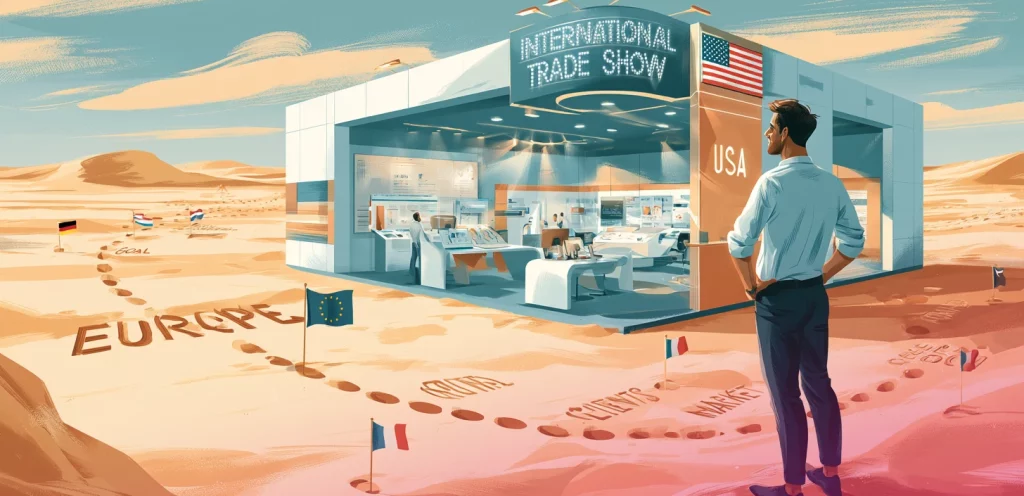

The booth space looks affordable. But what will the entire trade show actually cost?
Before you sign the contract, let’s look at your objectives, the customers you want to meet, and the expenses that rarely appear in the organizer’s initial quote.
5. Understand the market before you try to sell in it
You can have an excellent product and a very capable sales team.
But if you assume customers in the United States, Germany, or Italy buy exactly the same way as customers in your home market, you may be in for a surprise.
Working on B2B events across different markets, I’ve seen how much business conversations, relationships, and purchasing decisions can vary.
And I’m not just talking about language.
Same product. Different customer expectations.
In Germany, you may encounter a stronger emphasis on preparation, structure, punctuality, and specifics.
Business communication in the Netherlands can be more direct and open.
In Italy, personal relationships and trust may play a bigger role in the early stages of doing business.
These are general observations, not rules.
I wouldn’t recommend building an international sales strategy around national stereotypes.
Before you exhibit in a new market, learn how your potential customers actually make purchasing decisions.
What information do they expect?
What builds trust?
How do they compare suppliers?
Who gets involved in the decision?
The answers can affect your product presentation, demo, sales materials, team composition, and even booth design.
And this works in both directions.
If you’re a U.S. company entering Europe, don’t assume that a strategy that works in Germany will work exactly the same way in Italy.
Both countries are in the EU, but they can still have very different business cultures.
If you’re a European company heading to the U.S., I’d also recommend reading what U.S. trade show visitors expect from European exhibitors and the mistakes European companies often make at their first U.S. trade show.
6. Only now decide how you want to participate
Now we can finally talk about the booth.
Look at how many decisions we’ve already made.
We know why we’re going, who we want to meet, whether there’s early interest, what the investment might look like, and what customers in that market expect.
Now we can decide what our presence should look like.
A bigger booth isn’t always a better investment
If your main objective is to meet ten strategic accounts, maybe what you really need is a comfortable place for serious conversations.
If you’re launching a product, a working demo might matter more.
If you’re an industrial company, you may need a machine, product samples, or a technical demonstration.
You could also:
- Exhibit together with a partner
- Join a national pavilion
- Rent a meeting room
- Organize a separate customer event
- Attend without your own booth
Yes, sometimes walking the show makes more sense than exhibiting.
Especially when your objective is to understand the event, explore the market, or have a limited number of prearranged meetings.
But the opposite can also be true.
If you’re entering a new market and want to build brand recognition, showing up with a presence nobody notices may be a mistake.
Sometimes you need to make a bigger commitment to get noticed.
An example from industrial trade shows in Hannover
We’ve worked with industrial companies exhibiting at trade shows in Hannover, Germany.
And one question came up in different forms.
The company has a large machine.
The obvious idea?
Bring the machine and put it on display.
But the machine itself doesn’t always do a great job of explaining how it works or what the customer actually gets from it.
For some projects, we used short animations showing the machine in action and the results it produced.
On a large booth screen, we could demonstrate in under a minute what might otherwise take a much longer explanation standing next to the machine.
Then we could move straight into a conversation about the customer’s needs.
That’s why I don’t begin booth design by asking what the booth should look like.
I start with a different question:
What does the customer need to see and understand before we can have a meaningful business conversation?
Sometimes the answer is the machine itself.
Sometimes it’s an animation, a working demo, a product sample, or something entirely different.
Once you know that, you can choose the right presentation format.
And only then can you build a much more accurate budget.
I’ve written more about this approach in building a sales funnel around a B2B trade show.
7. Build a plan for the entire project, including what happens afterward
You’ve selected the show, defined the objective, estimated the budget, and chosen how you want to participate.
Now you have to make it happen.
On a large international project, the list of moving parts can be enormous.
Booth production. Shipping. Technical services. Organizer deadlines. Marketing materials. Travel. Customer meetings.
Different people may be responsible for different parts.
Marketing prepares the communication.
Sales schedules the meetings.
An agency manages the booth.
A freight forwarder handles shipping.
Local contractors take care of technical services.
Everything looks fine until the responsibilities start falling through the cracks.
Someone needs to own the entire project.
Who actually needs to be at the show?
I wouldn’t focus only on how many people the company is sending.
I’d focus on what those people need to be able to do.
If you’re selling a complex technical solution, salespeople alone may not be enough.
If you’re meeting strategic customers, having the CEO, owner, or another senior decision-maker there can make a significant difference.
Your team should reflect the objective and the type of conversations you expect to have.
The trade show starts before the doors open
I still see companies putting most of their energy into preparing the event itself.
The booth has to be ready.
The brochures have to be printed.
The team has to arrive on time.
And then?
We’ll see who shows up.
That’s a risky approach to B2B sales.
I prefer to think about the entire process in three stages.
Before the show
Identify target accounts, reach out to the right people, build interest, and schedule meetings.
During the show
Have the conversations, qualify contacts, understand customer needs, and agree on next steps.
After the show
Deliver on what was agreed.
A demo. A proposal. A technical meeting. An introduction to another stakeholder. A call on a specific date.
And this brings us to a mistake that can waste a significant part of the work done during the event.
Plan your follow-up before you leave
If your team comes back from a trade show and only then starts figuring out what to do with all the contacts, the planning started too late.
Follow-up shouldn’t be figured out after the show. After the show, it should be executed.
Before you leave, decide who owns the next steps, where the information from conversations will be recorded, and how follow-up will be managed.
Not every contact is a sales opportunity.
Not every conversation requires a proposal.
But after a meaningful meeting, you should know what happens next.
That’s the thinking behind using B2B events to drive sales.
Seven questions to answer before you go
You don’t need to begin with a massive project plan and dozens of spreadsheets.
Start with seven questions.
- Why are we going? What business result do we expect, and how will we measure it?
- Who do we want to meet? Will our potential customers actually be there?
- Have we tested their interest? Have we tried reaching the right people before committing?
- What will it really cost? Do we understand the scale of the investment?
- Do we understand the market? Do we know how customers make purchasing decisions?
- How should we participate? What format best supports our objective?
- Who owns the entire project? What’s the plan before, during, and after the show?
If you have solid answers, you can move on to booth space, design, shipping, technical services, and everything else.
If you don’t, I’d think twice before spending the money.
I’ve seen plenty of beautifully executed trade shows.
But a well-organized event doesn’t automatically mean exhibiting was a good business decision.
You can design a great booth in a few weeks. But even the best booth won’t save you from choosing the wrong show.
FAQ
Frequently Asked Questions About International Trade Show Preparation
How do you choose the right international trade show?
Start with your business objective.
Then look at the attendee profile: industries, job functions, company types, countries, and historical attendance data.
Compare that information with your existing customers, target accounts, and the market you want to reach.
If possible, contact a few of the companies you’d like to meet before committing. Their response can tell you more about the event’s relevance than a headline attendance figure.
Which KPIs should you set for a trade show?
It depends on what you’re trying to achieve.
Useful KPIs include meetings with qualified prospects, new contacts matching your ideal customer profile, new sales opportunities, progress on existing opportunities, meetings with current customers, and specific market feedback.
Choose a few metrics that genuinely reflect your objectives.
There’s no point measuring everything just because you can.
Is it worth attending a trade show without exhibiting?
Sometimes, absolutely.
In the U.S., this is often called walking the show.
If your objective is to understand the event, explore a market, or have a few meetings arranged in advance, attending without your own booth can be a smart decision.
If you’re trying to build brand visibility in a new market, exhibiting may be much more important.
The right choice depends on what you’re trying to accomplish.
How early should you start preparing for an international trade show?
For major international trade shows, preparation may begin 9–12 months in advance.
For smaller events, 3–6 months may be sufficient.
These are general planning ranges, not universal rules.
The timeline depends on the event, booth requirements, available space, shipping, and organizer deadlines.
The most important thing is to define your objective, initial budget, and participation format before production and logistics begin.
What information should you ask the trade show organizer for?
Ask for audience data from previous editions.
That includes industries, countries, company types and sizes, job functions, and attendee profiles.
It’s also worth asking about the exhibitor mix and how the organizer plans to attract visitors to the next edition.
A large attendance number means very little if the people you want to do business with aren’t there.
How much does it cost to exhibit at an international trade show?
It depends on the country, event, booth size and format, shipping, technical services, travel, and team requirements.
Floor space is only one part of the budget.
Start with a realistic estimate of the total investment. Once you’ve decided how to participate, build a detailed project budget.
If you’re exhibiting in the United States, see what a U.S. trade show really costs.
About the Author
Tomasz Pisinski, Eventguru
Tomasz has worked on B2B events across Europe and the United States for more than a decade. At Eventguru, he helps companies plan and execute trade show participation around business objectives, market realities, and the sales process.
Planning an International Trade Show?
Before you book floor space and start designing the booth, let’s find out whether the event actually makes sense for your business.
We can work through your objectives, event selection, target accounts, budget, and participation format.
Already decided to exhibit?
Eventguru can also plan and deliver your trade show project, including booth production and on-site support.